


Learn · Feng Shui
Feng Shui: Principles, Schools and Practical Home Layout
Feng shui, literally “wind and water”, is the Chinese practice of placing graves, buildings and rooms so that they sit well in their surroundings. It grew out of much older Chinese ways of choosing burial and building sites, and developed into a detailed craft with two main schools: one that reads the shape of the land and the room, and one that reads compass directions and time. This page explains where feng shui comes from, how each school works, and how its main ideas apply to an ordinary home today.
⚡ KEY TAKEAWAYS: Feng Shui Principles and Schools
- Feng shui, “wind and water”, is the Chinese practice of placing graves, buildings and rooms so that they sit well in their surroundings, guided by the idea of qi, vital breath.
- The Form School reads the shape of the land and the room; the Compass School reads directions and time with a luopan, through methods such as Eight Mansions and Flying Stars.
- At home, practitioners begin with the front door, the commanding position of the bed, desk and stove, and clearing clutter; no object or cure guarantees an outcome.
Key Terms
| Term | Meaning |
|---|---|
| Qi | Vital breath; the living quality a well-placed site holds. |
| Yin and yang | The paired qualities, such as dark and light, in every space. |
| Five Elements | Wood, fire, earth, metal and water, as phases of change. |
| Bagua | The eight trigrams arranged around a centre. |
| Luopan | The feng shui compass, with rings of directions and cycles. |
| Form School | The school that reads landforms and the shape of spaces. |
| Compass School | The school that reads directions and time. |
| Kua number | A number from your birth year that sets your favourable directions. |
| Sha qi | Harsh qi from straight lines and sharp edges. |
What Feng Shui Means
The name comes from one of the oldest texts of the tradition, the Book of Burial (Zàngshū, 葬書), traditionally attributed to the scholar Guo Pu (276 to 324), though the text as it survives was probably shaped by later hands. Its central idea is that vital breath (qì, 氣) scatters when the wind carries it and gathers where it meets water. A good site, then, is one that shelters this breath from the wind and holds it with water. Practitioners took the two words, wind and water, as the name of the whole art.
Qi is the key concept. Translations often call it “energy”, but the older sense is closer to breath: the living quality that a well-placed site seems to have and a badly placed one lacks. A house tucked into a slope, sheltered from cold winds and facing a gentle stream, is the classic picture of a site where qi gathers. A house on an exposed ridge, or at the end of a road that runs straight at its door, is the classic picture of one where qi is lost or turns harsh.
The tradition separates two kinds of site. Yin dwellings (yīnzhái) are graves, and yang dwellings (yángzhái) are houses for the living. For much of Chinese history the siting of ancestral graves mattered as much as the siting of homes, because families held that the fortunes of the living were tied to the resting place of the dead. Most feng shui practised outside China today deals only with yang dwellings: homes, offices and shops.
A Short History
Feng shui grew from the cosmology of early China: the paired forces of yin and yang, the five phases, and the eight trigrams of the Book of Changes (Yìjīng). By the Han dynasty, specialists were already judging sites for tombs and settlements, and the Book of Burial supplied the phrase from which the art later took its name. Earlier writers more often called it kanyu or dili, and the term feng shui came into common use only around the Song dynasty.
Two schools took shape over the following centuries. The Form School is traditionally traced to Yang Yunsong, a master of the Tang dynasty, and grew strongest in the hilly south-west of China, where mountains and rivers gave plenty to read. The Compass School developed in Fujian in the Song dynasty and relied on the luopan, the feng shui compass, with its rings of directions, trigrams and time cycles. Practitioners today usually combine the two, reading the form of a site first and its directions second.
In mainland China the practice was discouraged after 1949 as superstition, though it continued quietly in the countryside. It flourished in Hong Kong, Taiwan, Singapore and Malaysia, where builders and banks still consult practitioners. From the 1970s it spread to the West, often in simplified forms. One well-known modern adaptation, the Black Hat method, is commonly credited to Thomas Lin Yun, who taught it in the United States from the 1980s, and it aligns the eight directions with the front door instead of the compass. Classical practitioners regard it as a modern school, not as the traditional method.
Scholars such as the anthropologist Ole Bruun have studied feng shui as a living tradition, practised in different ways by village specialists, urban consultants and households, and that variety is worth keeping in mind. There is no single authority, and practitioners disagree on many points of method.
The Core Ideas
Yin and Yang
Yin and yang are the paired qualities found in everything: dark and light, still and moving, soft and hard, cool and warm. A space feels right when the two are in proportion to its use. A bedroom leans yin: quiet, dim, restful. A living room or shop leans yang: bright, active, open. Many common complaints about a room, that it feels gloomy or that it is impossible to relax in, are read as an imbalance of the two.
The Five Elements
The five elements (wǔxíng, more exactly the five phases) are wood, fire, earth, metal and water. They are not substances but stages of change, and they act on one another in two cycles.
| Cycle | Sequence | Image |
|---|---|---|
| Productive | Wood feeds fire, fire makes earth, earth bears metal, metal gives rise to water, water nourishes wood | Each phase gives rise to the next |
| Controlling | Wood breaks through earth, earth dams water, water puts out fire, fire melts metal, metal cuts wood | Each phase restrains another |
Practitioners use the cycles to strengthen or calm an area. A space associated with wood can be supported by the water element, such as a small water feature, while too much metal is said to restrain it; plants themselves stand for wood. Colours, shapes and materials stand for the elements: green and tall shapes for wood, red and pointed shapes for fire, yellow and flat shapes for earth, white and round shapes for metal, black and wavy shapes for water.
The Bagua
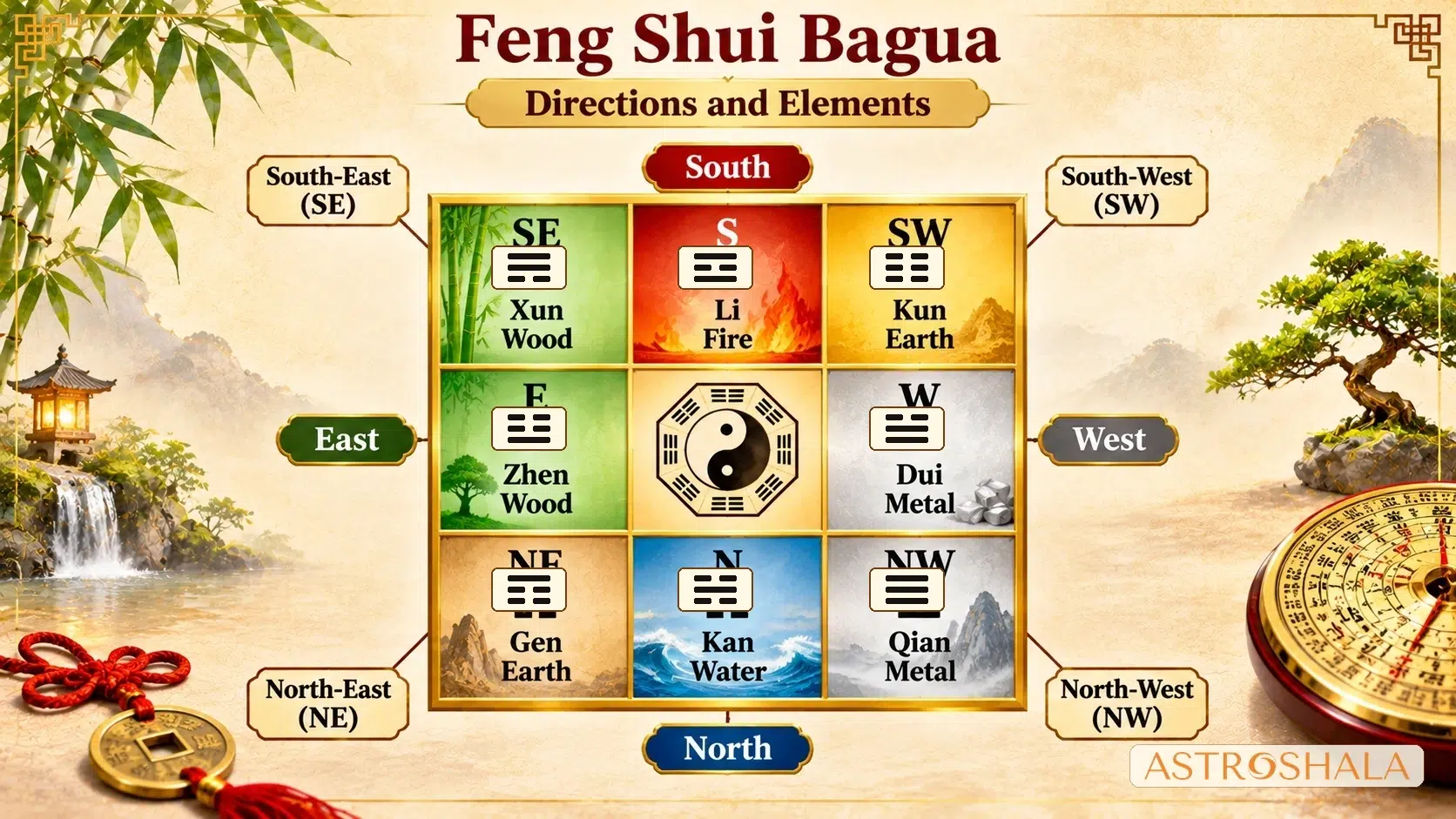
The bagua (bāguà, eight trigrams) arranges the eight trigrams of the Book of Changes around a centre. For houses, practitioners use the Later Heaven arrangement, which links each trigram to a direction, an element and a member of the family.
| Direction | Trigram | Element | Family member | Area of life (popular use) |
|---|---|---|---|---|
| South | Li, fire | Fire | Middle daughter | Fame and reputation |
| North | Kan, water | Water | Middle son | Career |
| East | Zhen, thunder | Wood | Eldest son | Family and health |
| South-east | Xun, wind | Wood | Eldest daughter | Wealth |
| South-west | Kun, earth | Earth | Mother | Relationships |
| North-west | Qian, heaven | Metal | Father | Helpful people and travel |
| West | Dui, lake | Metal | Youngest daughter | Children and creativity |
| North-east | Gen, mountain | Earth | Youngest son | Knowledge |
The last column belongs mainly to modern popular feng shui. Classical practitioners work more with the directions, elements and family members, and read the life areas with caution.
Planning a move? Choose the date by your horoscope
Feng shui guides the layout; AstroShala does not offer feng shui assessments. What we offer is an auspicious date for the move, the house-warming or the start of building, chosen from your horoscope in a 30-minute call.
The Two Schools
The Form School
The Form School (luántóu, 巒頭, literally “peaks and summits”) reads shape: hills, water, roads, neighbouring buildings and, indoors, the shape of rooms and the placing of furniture. Its model site is described through four animals of the sky:
- The Black Tortoise behind: high ground or a taller building at your back, for support
- The Red Phoenix in front: open, lower ground before you, for an unobstructed view
- The Green Dragon on the left: slightly higher ground or buildings on the left as you look out
- The White Tiger on the right: slightly lower ground on the right
Left and right are read from the site, looking out towards its open front. The result is the shape of an armchair: solid at the back, arms on each side, open in front. The same pattern guides the placing of a bed or a desk.
The Form School also watches for harsh qi (shā qì, 煞氣), often called poison arrows in English: straight lines and sharp edges pointing at a door, a bed or a seat. A road running straight at a front door, the sharp corner of a neighbouring building, or an exposed beam over a bed are the standard examples.
The Compass School
The Compass School (lǐqì, 理氣, “principles of qi”) reads directions and time with the luopan. Its two best-known methods are:
- Eight Mansions (bāzhái): divides a house into eight directional sectors and matches them with a person’s Kua number, giving each person four favourable and four unfavourable directions.
- Flying Stars (xuánkōng fēixīng): adds time. It charts how the qualities of each sector change through cycles of twenty years, and through each year and month. The current cycle, Period 9, began in February 2024 and runs to early 2044.
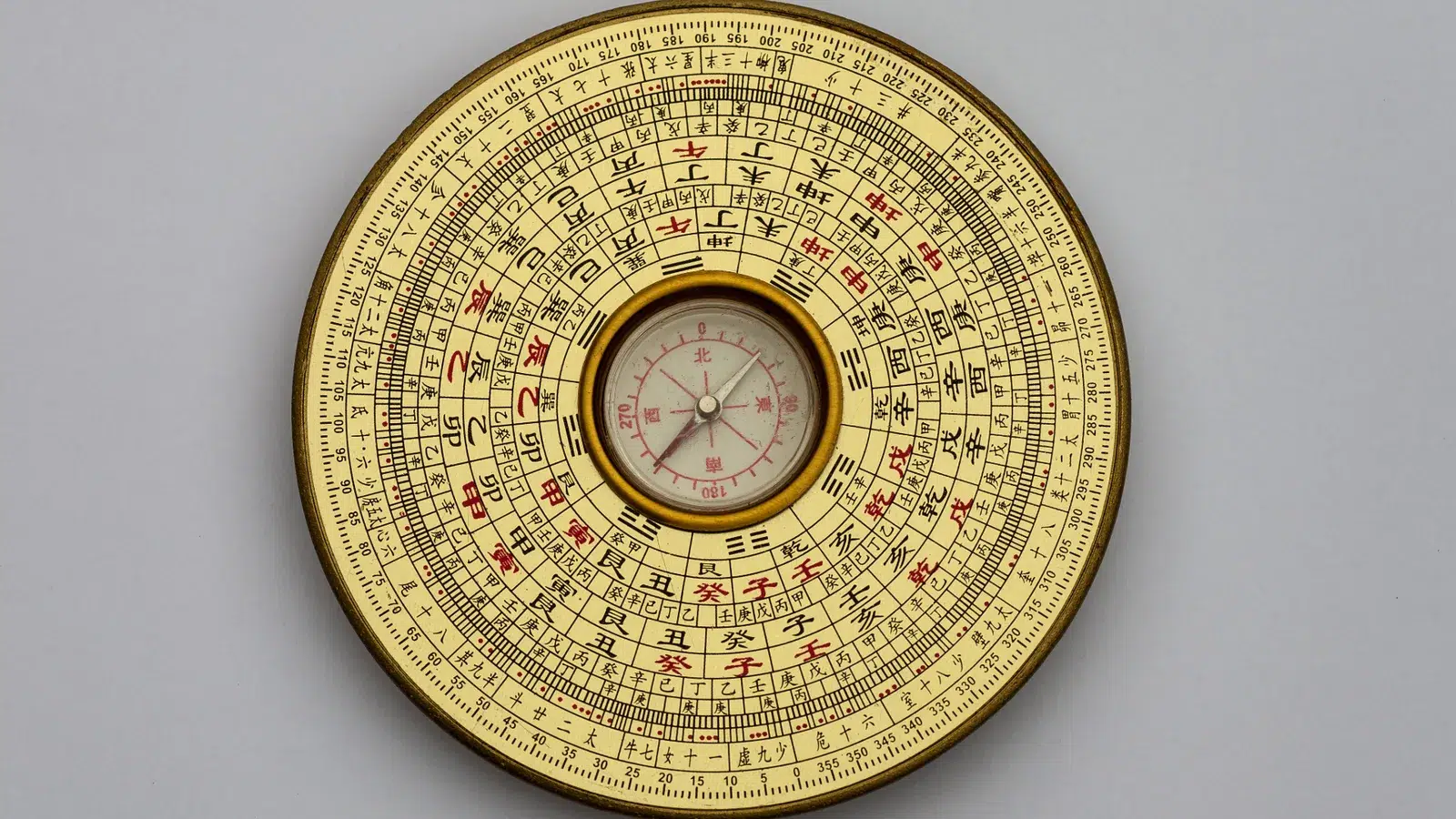
Flying Stars needs the exact facing direction of the building and the period in which it was built or substantially renovated, which is why serious practitioners take careful compass readings before giving advice. Schools also differ on what counts as a renovation large enough to change a building’s period, so an interior refit does not automatically give a house a new chart.
In outline, Flying Stars works like this. The nine numbers of the Lo Shu square are treated as nine “stars”, each with its own character, favourable or troublesome depending on the period. For each building, a practitioner draws a natal chart from two facts: the period in which it was built or substantially renovated, and its exact facing direction. Every sector of the chart then carries three numbers: the period star; the mountain star, read for health and relationships; and the water star, read for money and opportunity. The annual and monthly stars move through the sectors on top of this fixed chart, which is why practitioners speak of a house’s underlying chart and, separately, of the influences of a particular year or month. Because the whole chart turns on the facing direction, a reading taken a few degrees wrong can produce a different chart, which is why careful compass work comes first.
Your Kua Number
The Kua number, used in the Eight Mansions method, comes from your year of birth and your sex. The year changes at the start of spring in the Chinese solar calendar (lì chūn), about 4 February, so anyone born in January or early February uses the previous year. The exact moment of the transition shifts a little from year to year, so if you were born between 3 and 5 February, check its time for your birth year rather than relying on the date alone.
To calculate it, add the last two digits of your birth year and reduce them to one digit. Then:
| Born | Men | Women |
|---|---|---|
| 1900 to 1999 | 10 minus the reduced number | 5 plus the reduced number, reduced again if needed |
| 2000 onwards | 9 minus the reduced number | 6 plus the reduced number, reduced again if needed |
A result of 5 is replaced: men use 2, and women use 8. A result of 0 counts as 9.
Example: born 23 March 1988. The last two digits, 8 and 8, add to 16, which reduces to 7. A man’s Kua number is 10 minus 7, which is 3. A woman’s is 5 plus 7, which is 12, reducing to 3. Both have Kua number 3.
Kua numbers fall into two groups. The East group (1, 3, 4 and 9) favours north, south, east and south-east. The West group (2, 6, 7 and 8) favours west, north-west, south-west and north-east. Practitioners use these to choose which way to face when you sleep or work, and where to place a desk or a bed when the room allows a choice. When two people share a bedroom and belong to different groups, practitioners usually favour the main earner’s directions or look for a compromise, and none of them insists on rebuilding a house for it. These directions are traditional Eight Mansions recommendations; they never override practical needs such as the room’s layout, ventilation, safety or the comfort of others who share it.
Practical Feng Shui for Your Home
Most of what practitioners advise for an ordinary home rests on the Form School, and much of it makes sense even to someone who never uses a compass.
The Front Door
Practitioners call the main door the mouth of the house, where qi enters. Keep it clear, well lit and easy to open fully. Clutter behind the door, a broken bell or a dark, cramped entrance are among the first things a practitioner points out. A front door that looks straight down a corridor to a back door is read as letting qi rush through; a screen, a plant or a piece of furniture that slows the line of sight is the usual answer.
The Commanding Position
The commanding position applies to the three most important pieces of furniture: the bed, the desk and the stove. Place each so that you can see the door from it without sitting or lying directly in line with it, ideally diagonally across the room, with a solid wall behind you. This is the armchair model of the Form School brought indoors, and its everyday sense is plain: people rest and work better when nobody can come up behind them unseen.
The Bedroom
Practitioners advise:
- A solid headboard against a solid wall, not under a window
- No exposed beam or heavy shelf directly over the bed
- No mirror facing the bed, a common caution because it is said to disturb rest
- Few electronic devices, and little clutter under the bed
The Kitchen
The stove stands for fire and the sink and refrigerator for water. Practitioners prefer not to place the stove directly opposite or right beside the sink, and where that cannot be changed, they put something of the wood element, such as a wooden board or a green item, between them, since wood sits between water and fire in the productive cycle.
Clutter, Light and Air
Practitioners of every school put great weight on keeping rooms clear of clutter. Stagnant corners, piles of unused things and broken objects are read as places where qi stops moving. Good natural light, fresh air and clear pathways through each room come first; objects come later.
Traditional Cures
Practitioners use objects to adjust a space: living plants for wood, small fountains or aquariums for water, wind chimes and bells to stir still corners, crystals to scatter light, and a bagua mirror, used only outside the house and facing outward, against harsh qi from a road or a sharp corner. These are traditional tools, not guaranteed fixes. Fit mirrors, chimes and other outdoor objects with care for safety, your neighbours, and any building or housing-society rules: a mirror that throws glare into a neighbour’s home creates a real problem in place of a symbolic one. Their visible value, more light, more order, better use of space, is something anyone can judge for themselves.
Feng Shui Plants
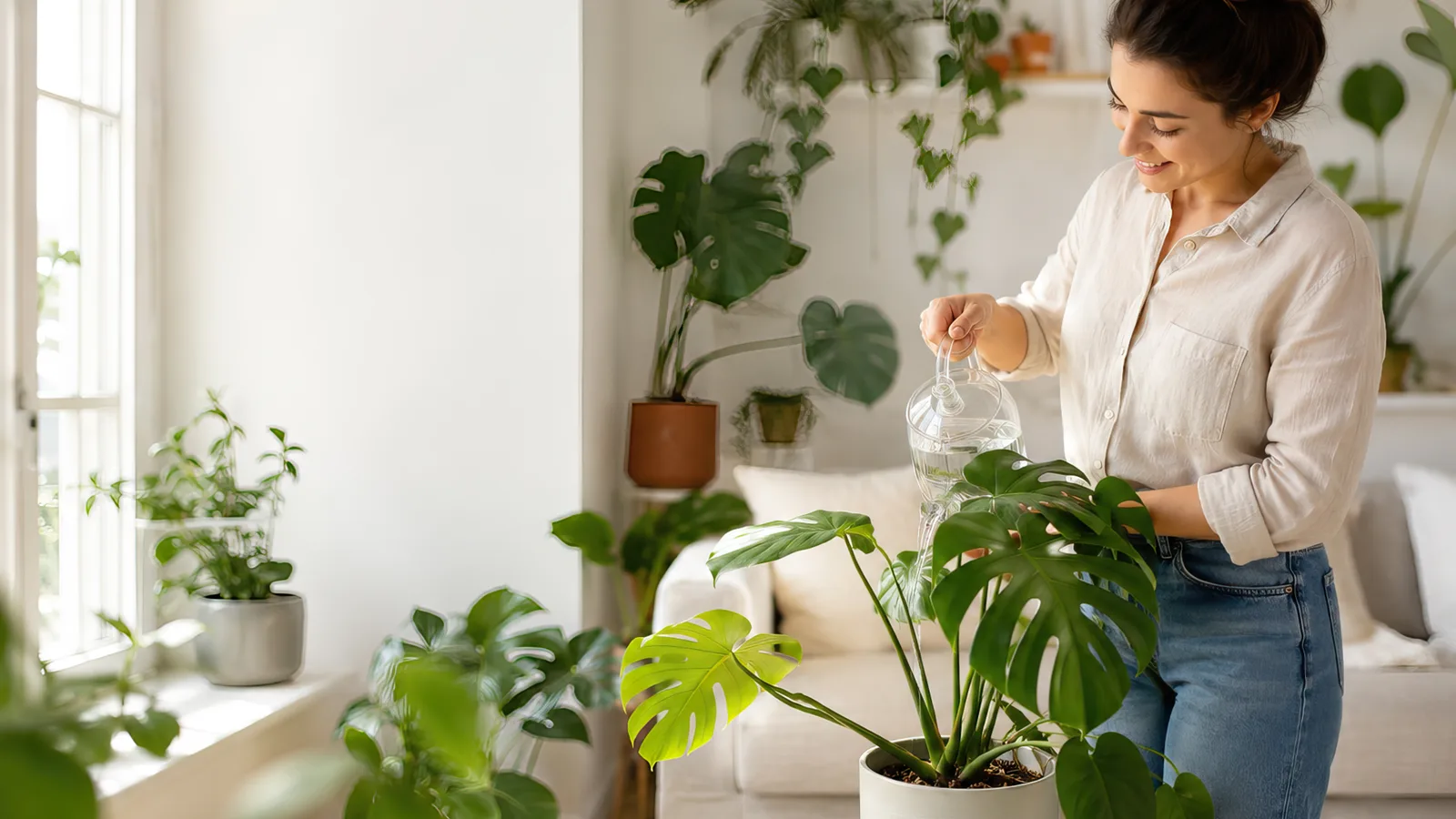
Plants are the cure readers ask about most. Practitioners favour healthy plants with soft, rounded leaves, which stand for the wood element and for steady growth: the jade plant (Crassula ovata), lucky bamboo (Dracaena sanderiana), which is not a true bamboo, and the money plant (Epipremnum aureum), long popular in Indian homes. Many practitioners advise keeping spiny cacti out of living and sleeping areas. All of them agree on one point: a dying or dusty plant does a room more harm than no plant at all, so choose plants that suit the light you have.
What Feng Shui Can and Cannot Do
Feng shui is a traditional art of placement, not a science. There is no reliable scientific evidence that a cure brings wealth, a better marriage or good health, and any practitioner who promises such results is promising more than the tradition can give. Be cautious of anyone who presses you to buy expensive cures, to make structural changes in a hurry, or to act out of fear of a bad direction.
What feng shui does offer is a long-tested habit of attention: to light, to air, to the way a building meets its site, to the way people move through a room, and to the quiet comfort of a bed or desk with a wall behind it. Many of its rules agree with ordinary good design. Used that way, it is a sound guide to making a home easier to live in.
For health, money or legal matters, feng shui is never a substitute for a doctor, a financial adviser or a lawyer.
Have questions your home alone can’t answer?
When the same problem keeps returning whatever you change at home, a detailed reading of your horoscope can show what your current period is bringing. This is an astrology reading, not a feng shui assessment.
Prefer to talk it through? Book a 30-minute call.
If You Also Follow Vastu
Many Indian homes are planned by Vastu Shastra, the Indian science of building, and readers often ask whether the two agree. They grew up separately, they use different maps of the house, and their advice sometimes conflicts. Vastu fixes the purpose of each direction for every household: it places the kitchen in the south-east, for example, because that zone belongs to fire. Eight Mansions feng shui instead gives each person favourable directions according to their Kua number. Mixing the two in one decision usually satisfies neither. Choose one framework for a given house and follow it consistently.
Frequently Asked Questions
Is feng shui a religion?
No. Feng shui is a traditional practice of placement that grew out of Chinese cosmology. It has links with Daoist ideas and popular religion, but people of any faith use it.
Does feng shui work?
There is no scientific proof that feng shui changes fortune. Many of its practical rules, such as good light, clear pathways and a protected place to sit or sleep, make a home more comfortable, and that is the part anyone can test for themselves.
What is the luckiest direction in feng shui?
There is no single lucky direction for everyone. In the Eight Mansions method, your favourable directions depend on your Kua number: the East group favours north, south, east and south-east, and the West group favours west, north-west, south-west and north-east.
How do I find my Kua number?
Add the last two digits of your birth year and reduce them to one digit. For births from 1900 to 1999, men subtract it from 10 and women add 5; from 2000 onwards, men subtract it from 9 and women add 6. If you were born before about 4 February, use the previous year.
Do I need to buy feng shui cures?
No. Clearing clutter, improving light and air, and placing the bed and desk in the commanding position cost little or nothing. Objects such as plants or wind chimes are optional, and none of them guarantees an outcome.
Can I use feng shui in a rented home?
Yes. Most practical advice, such as furniture placement, clutter, light and small additions like plants, needs no structural change, which makes it well suited to a rented flat.
Texts Referred To
- Book of Burial (Zàngshū), attributed to Guo Pu.
- Book of Changes (Yìjīng).
- Ole Bruun, An Introduction to Feng Shui, Cambridge University Press, 2008.
- Further reading: Feng shui (Encyclopaedia Britannica)