




Remedies, The Nine Planets in Astrology
Why Vishnu Became the Nine Planets: The Avatars of the Grahas in Parashara
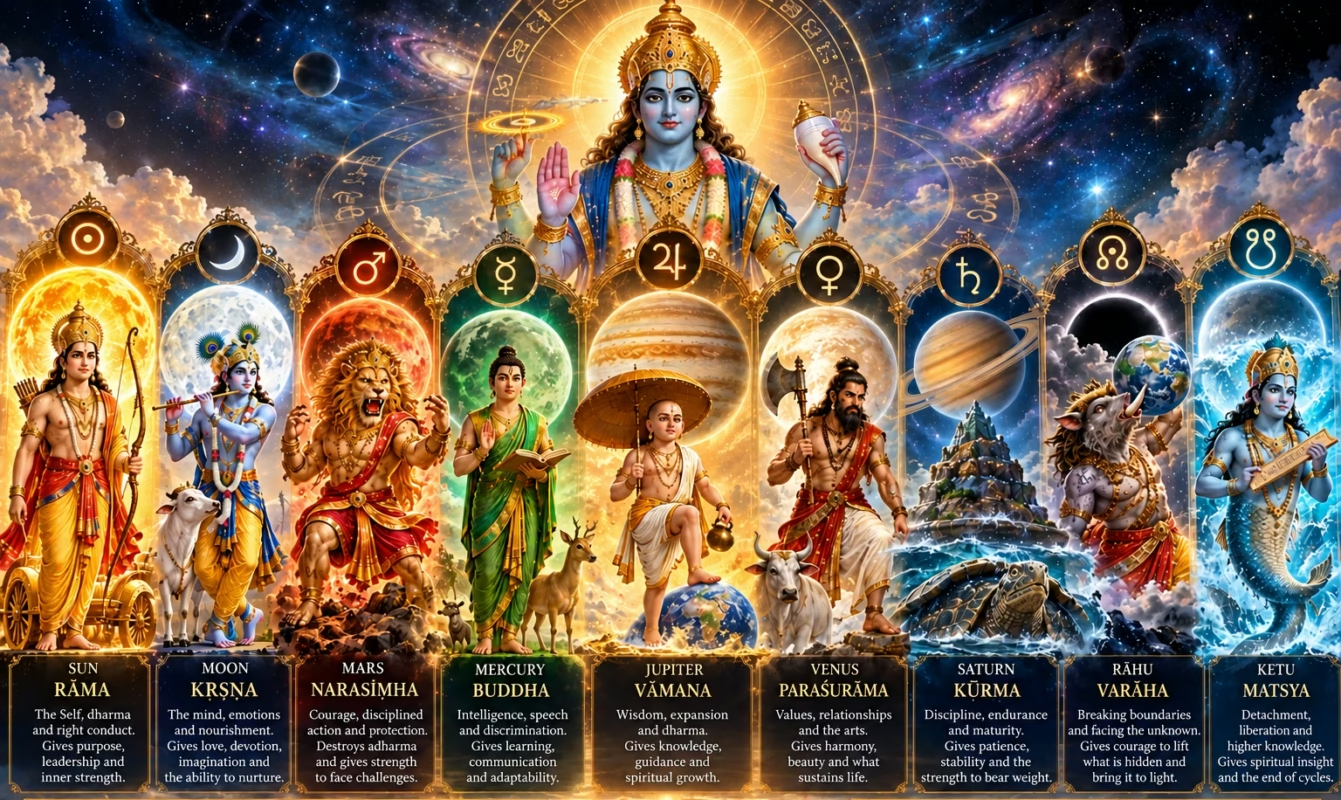
Dec
⚡ KEY INSIGHTS: The 9 Vishnu Avatars and Planets
In the second chapter of the Bṛhat Parāśara Horā Śāstra, Parāśara teaches that Lord Viṣṇu takes the form of the nine planets to give every living being the results of its own actions. He pairs each planet with an avatar: Rāma with the Sun, Kṛṣṇa with the Moon, Narasiṁha with Mars, Buddha with Mercury, Vāmana with Jupiter, Paraśurāma with Venus, Kūrma with Saturn, Varāha with Rāhu, and Matsya with Ketu. Read together, the pairings show what each planet is for at its highest.
Key Terms Used in This Article
| Term | Meaning |
|---|---|
| Avatāra | A descent; a form the Lord takes to act within the world |
| Graha | A planet; literally “that which seizes”, the nine influences read in a birth chart |
| Navagraha | The nine grahas: Sun, Moon, Mars, Mercury, Jupiter, Venus, Saturn, Rāhu and Ketu |
| Daśāvatāra | The ten best-known avatars of Viṣṇu, of whom Kalki is still to come |
| Aṁśa | A portion or share |
| Paramātmāṁśa | A portion of the Supreme Self |
| Jīvāṁśa | A portion of the individual soul |
| Pūrṇāvatāra | A complete incarnation, in which the Supreme Self is present in full |
| Karmaphala | The fruit of action, which the grahas deliver |
| Vibhūti | A manifestation in which the Lord shows his glory, as in “among the months, I am Mārgaśīrṣa” |
| Daśā | A planetary period, during which one graha’s results come to the fore |
Why the Nine Planets Have Avatars
Most of astrology treats the planets as forces. Saturn delays, Jupiter expands, Mars cuts. That language is useful, and every practitioner uses it, but on its own it leaves the planets as machinery: impersonal, indifferent, and frightening when the chart turns hard.
Parāśara does not leave them there. Before he teaches a single rule of chart reading, he answers a question his student Maitreya asks about the incarnations of Viṣṇu, and his answer places the grahas within God’s life. He says the planets are the forms through which the Lord himself returns to each of us what we have done.
That changes how a difficult period feels from the inside. A Saturn daśā that strips away comfort is no longer a cold mechanism grinding on. It is Janārdana, the Lord people turn to in need, settling an old account in the form best suited to do so. The difficulty is the same, but someone who understands its purpose can meet it differently.
Pairing each planet with one of the Vishnu avatars is the practical expression of that teaching. In the reading this article offers, an avatar shows a planet’s purpose in a life: Rāma shows what the Sun is for, and Kūrma what Saturn is for. Read this way, the nine avatars become a guide to the highest work of each graha, and so to the highest use of each planet in a birth chart.
What Parashara Teaches: Vishnu as the Nine Grahas
The teaching comes in the second chapter of the Bṛhat Parāśara Horā Śāstra, the chapter on the incarnations (avatāra kathana). It is placed there deliberately. Parāśara has just described the creation; before he names a single sign or house, he tells his student what the planets are.
अवताराण्यनेकानि ह्यजस्य परमात्मनः ।
जीवानां कर्मफलदो ग्रहरूपी जनार्दनः ॥३॥avatārāṇyanekāni hyajasya paramātmanaḥ
jīvānāṁ karmaphalado graha-rūpī janārdanaḥThe unborn Supreme Self has many incarnations. Janārdana, taking the form of the planets, gives living beings the fruits of their actions.
Bṛhat Parāśara Horā Śāstra 2.3
The next verse gives the purpose.
दैत्यानां बलनाशाय देवानां बलवृद्धये ।
धर्मसंस्थापनार्थाय ग्रहाज्जाताः शुभाः क्रमात् ॥४॥daityānāṁ balanāśāya devānāṁ balavṛddhaye
dharma-saṁsthāpanārthāya grahāj jātāḥ śubhāḥ kramātTo break the strength of the daityas, to increase the strength of the devas, and to establish dharma, the auspicious ones were born from the planets, one after another.
Bṛhat Parāśara Horā Śāstra 2.4
Two things in these verses deserve attention.
The planets give what has been earned. Parāśara’s phrase, giver of the fruit of action (karmaphalada), defines the graha by its function. A planet does not invent a person’s fortune. It returns, at the proper time, what the person has already set in motion. On that definition, the birth chart is a ledger, and the daśā sequence is the order in which its entries fall due.
The avatars come from the planets, not the planets from the avatars. Verse 4 says the auspicious ones were born from the grahas (grahāj jātāḥ). The plain reading is not that Rāma was assigned to the Sun after the fact, as a convenient label. Rather, the power that descended as Rāma is the power that works through the Sun.
This is why the three aims of verse 4 matter for chart reading. On Parāśara’s account, every graha, however harsh its effects, works for dharma. The demons it weakens are not only the daityas of the Purāṇas. Read in a human life, they are the habits, appetites and evasions that stand between a person and their own right course. When Saturn takes something away, the question worth asking is which daitya it is weakening.
Full and Partial Incarnations
The chapter opens with a question that most readers skip, and it is the key to the whole teaching. Maitreya asks whether Rāma, Kṛṣṇa and the other incarnations also carry a portion of individual soul (jīvāṁśa), as ordinary beings do. Parāśara answers:
रामः कृष्णश्च भो विप्र नृसिंहः सूकरस्तथा ।
एते पूर्णावताराश्च ह्यन्ये जीवांशकान्विताः ॥२॥rāmaḥ kṛṣṇaśca bho vipra nṛsiṁhaḥ sūkarastathā
ete pūrṇāvatārāśca hyanye jīvāṁśakānvitāḥRāma, Kṛṣṇa, Narasiṁha and the Boar are complete incarnations, O Brahmin. The others are joined with portions of individual soul.
Bṛhat Parāśara Horā Śāstra 2.2
Four avatars, then, are complete (pūrṇāvatāra): in them the Supreme Self is present in full, with nothing of a limited, individual soul mixed in. The other five of the nine are partial. They are true descents of the Lord, but they also carry an individual portion.
Verses 7 and 8 turn the same distinction on every being born of the planets. Where the portion of the Supreme Self (paramātmāṁśa) predominates, Parāśara calls the being celestial (khecara, one who moves in the sky). Where the individual portion predominates, the being is a jīva, an individual soul. And he adds that portions of the Supreme Self flow out from the Sun and the other planets.
What the four complete incarnations show
Look at where the four complete avatars fall. Rāma belongs to the Sun, Kṛṣṇa to the Moon, Narasiṁha to Mars, and Varāha to Rāhu.
The two luminaries are the obvious pair. The Sun is the soul and the Moon is the mind, and between them they decide how much light any chart can receive. It is fitting that the two most fully worshipped avatars of Viṣṇu should belong to them.
The other two are less expected. Mars and Rāhu are the two grahas a frightened client most often asks about, and Parāśara places a complete incarnation in each. This is a reading of the verse, not a statement of it: the planets that frighten us most are not the ones in which the Lord is least present. It is a theological point, not a measure of strength. A complete incarnation describes the avatar; it does not make Mars or Rāhu any stronger in a particular chart.
What the teaching means for chart reading
Every person, by Parāśara’s account, is a jīva, a being in whom the individual portion predominates, while the planets carry the portion of the Supreme Self. A birth chart is where the two meet. That is why the grahas cannot be bargained with, since they return what was done, and also why they are not hostile: the one returning it is the Lord, acting for the native’s own dharma.
The Nine Vishnu Avatars and Their Planets
Parāśara gives the pairings in three verses.
रामोऽवतारः सूर्यस्य चन्द्रस्य यदुनायकः ।
नृसिंहो भूमिपुत्रस्य बुद्धः सोमसुतस्य च ॥५॥
वामनो विबुधेज्यस्य भार्गवो भार्गवस्य च ।
कूर्मो भास्करपुत्रस्य सैंहिकेयस्य सूकरः ॥६॥
केतोर्मीनावतारश्च …rāmo’vatāraḥ sūryasya candrasya yadunāyakaḥ
nṛsiṁho bhūmiputrasya buddhaḥ somasutasya cavāmano vibudhejyasya bhārgavo bhārgavasya ca
kūrmo bhāskaraputrasya saiṁhikeyasya sūkaraḥketor mīnāvatāraśca …
Rāma is the incarnation of the Sun; the leader of the Yadus, of the Moon; Narasiṁha, of the son of the Earth; Buddha, of the son of Soma. Vāmana is the incarnation of the one the gods worship; the Bhārgava, of the Bhārgava; Kūrma, of the son of the Sun; the Boar, of the son of Siṁhikā. The Fish is the incarnation of Ketu.
Bṛhat Parāśara Horā Śāstra 2.5 to 7
The verses do more than list. Parāśara names most planets with an epithet, and several epithets already contain the reason for the pairing.
| Planet | Parāśara’s name for it | Avatar | Link in the text or lineage | Interpretive link |
|---|---|---|---|---|
| Sun | Sūrya | Rāma | Rāma is born in the solar dynasty of Ikṣvāku | The given word kept at any cost |
| Moon | Candra | Kṛṣṇa, “leader of the Yadus” | The Yadus are a lunar dynasty | The mind drawn by what it loves |
| Mars | Bhūmiputra, son of the Earth | Narasiṁha | None stated | Bursting from a stone pillar; the exact, decisive act |
| Mercury | Somasuta, son of Soma | Buddha | Budha and Buddha share the root budh, to know | An intelligence that takes the nature of its company |
| Jupiter | Vibudhejya, worshipped by the gods | Vāmana | None stated | The teacher’s greatness that begins by asking little |
| Venus | Bhārgava, of Bhṛgu’s line | Paraśurāma, “the Bhārgava” | Both belong to the lineage of Bhṛgu | Vitality and power over death, won through austerity |
| Saturn | Bhāskaraputra, son of the Sun | Kūrma | None stated | Bearing the mountain through the whole churning |
| Rāhu | Saiṁhikeya, son of Siṁhikā | Varāha | None stated | The dive to the bottom of the cosmic waters |
| Ketu | Ketu | Matsya | None stated | Carrying the Vedas through the flood |
The first three columns come from the verse. The fourth gives the links that rest on a dynasty, a lineage or a shared word root, and says so where there is none. The fifth is interpretation, developed for each pair below.
Rama and the Sun
Rāma is born into the solar dynasty of Ikṣvāku, the line that traces its descent from the Sun himself. The pairing begins with blood, but it does not end there.
In a chart, the Sun is the soul (ātmā), the father, and the king. Rāma is all three in their purest and most costly form. He gives up a throne on the eve of his coronation so that his father’s word to Kaikeyī will not be broken. That is the Sun’s particular virtue: a word given is a word kept, whatever it costs the one who keeps it.
The Rāmāyaṇa adds a detail no Jyotiṣī should miss. On the battlefield before the last fight with Rāvaṇa, exhausted, Rāma is taught the hymn to the Sun (Āditya Hṛdaya) by the sage Agastya (Yuddha Kāṇḍa). The Sun’s incarnation recovers his strength by worshipping the Sun.
The tradition is also frank about what that virtue costs. In the Uttara Kāṇḍa, the same Rāma who keeps every vow sends Sītā away to protect the dignity of the throne. Reading that episode as the Sun’s shadow is interpretation, not doctrine. Even so, natives with a dominant Sun often recognise the tension in themselves when it is put to them: the word kept to the world, and the cost of keeping it paid at home.
Krishna and the Moon
Parāśara does not call him Kṛṣṇa. He calls him the leader of the Yadus (yadunāyaka), and that title carries the pairing. The Yadu line descends from Purūravas, the son of Budha, who is the son of the Moon: it is a lunar dynasty.
The Moon in a chart is the mind (manas), the mother, and the capacity for feeling and delight. Kṛṣṇa has two mothers, Devakī who bore him and Yaśodā who raised him, and the Moon itself has two faces, the waxing and the waning. He is born in the dark half of the month, at midnight, in the asterism Rohiṇī, which falls in Taurus, the sign of the Moon’s exaltation. The Bhāgavata sets his circle dance with the gopīs (rāsa) on an autumn night as the Moon rises, and tradition places it on the full Moon of Śarad.
Kṛṣṇa draws the mind, and settling on what it loves is the Moon’s proper work. When the Moon is weakened, typically by Saturn or the nodes, the mind keeps moving from one object to the next. The classical answer is not to suppress that restlessness but to give the mind something worth settling on, which is why devotion is the traditional remedy for an unsettled Moon.
Narasimha and Mars
Parāśara calls Mars the son of the Earth (bhūmiputra). Narasiṁha, the man-lion, emerges from a stone pillar in Hiraṇyakaśipu’s palace (Bhāgavata Purāṇa, Canto 7, Chapters 8 and 9). Read against the epithet, the power that bursts out of stone is the power of the Earth’s son.
The story is a study in Martian precision. Hiraṇyakaśipu has a boon that he cannot be killed by man or beast, by day or night, indoors or out, on the ground or in the sky, or by any weapon. Narasiṁha is neither man nor beast. He comes at twilight, on the threshold, holds the demon on his lap, and kills him with his nails. Every condition is met exactly, and none is broken. That is Mars at its best: the decisive act at the precise point.
The second half of the story matters as much. After the killing, Narasiṁha’s rage does not subside, and even the gods are afraid to approach him. It is Prahlāda, the child he came to protect, who calms him.
In consultation: with a fierce Mars, the useful question is rarely whether the native has courage. It is what the courage is attached to. Mars with nothing to protect tends to turn its heat on whoever is nearest.
Buddha and Mercury
Parāśara calls Mercury the son of Soma (somasuta), that is, of the Moon. His name, Budha, and the name Buddha both come from the root budh, to awaken or to know. Mercury is the planet of intelligence (buddhi): discrimination, speech, calculation, the capacity to distinguish one thing from another.
The Purāṇic accounts of the Buddha avatar are notably ambivalent. The Bhāgavata Purāṇa (1.3.24) describes him appearing in the land of Kīkaṭa to bewilder those hostile to the gods. He teaches, and the teaching works differently on different hearers. That ambivalence is itself Mercurial. Mercury is the one graha that takes on the nature of whatever it joins: benefic with benefics, malefic with malefics. The intelligence is a tool, and what it builds depends on who holds it.
This is why Mercury is judged by its company before it is judged on its own. Joined with Jupiter, the same intelligence serves understanding. Joined with an afflicting Mars or Saturn, it can as easily serve a clever argument that reaches the wrong conclusion.
The Balarama question
Many readers know a list of ten avatars that includes Balarāma, Kṛṣṇa’s elder brother, and some lists put Balarāma where Buddha stands. Jayadeva’s Gīta Govinda names both, treating Kṛṣṇa as the source of all ten. For the planetary pairing, the text is clear: Parāśara’s verse names Buddha (buddhaḥ somasutasya) for Mercury. A table that gives Balarāma for Mercury is following a different list of avatars, not Parāśara.
Vamana and Jupiter
Parāśara names Jupiter the one the gods worship (vibudhejya): Bṛhaspati, their teacher. His avatar arrives as a teacher’s student would, a small Brahmin boy with a staff and an umbrella, asking a king for alms (Bhāgavata Purāṇa, Canto 8, Chapters 18 to 23).
The king is Bali, ruler of the asuras, who has taken the three worlds. Vāmana asks him for three paces of land. Bali’s own guru, Śukra, recognises Viṣṇu at once and warns him not to give. Bali refuses the warning: he has promised, and he will not take back a gift. Vāmana then grows until his first step covers the earth and his second the heavens. For the third, Bali offers his own head.
Read with a Jyotiṣī’s eye, this is a contest of the two gurus. Jupiter’s avatar asks; Venus, the teacher of the asuras, advises against giving. Jupiter wins, and it wins through smallness. The dwarf becomes the measure of the universe only after he has asked humbly for very little. Bali, who loses everything, is given a world of his own, with the Lord as his doorkeeper. Jupiter’s grace often looks like loss at first.
Jupiter signifies wisdom, children, dharma, and giving (dāna), and Vāmana’s story ties all four to humility: he asks for very little, and what he asks for turns out to contain everything. In chart work, the story also warns against Jupiter’s excess. Growth without measure, or dāna made for show, is Jupiter forgetting the dwarf it began as.
Parashurama and Venus
The verse plays on one word: the Bhārgava is the incarnation of the Bhārgava (bhārgavo bhārgavasya). Both Paraśurāma and Venus belong to the lineage of the sage Bhṛgu. Paraśurāma is the son of Jamadagni and a descendant of Bhṛgu. Venus is Śukra, the son of Bhṛgu himself, and he is called Bhārgava throughout the Purāṇas.
This pairing surprises readers who know Venus only as the planet of beauty, comfort and love. Paraśurāma is the fiercest avatar, an ascetic with an axe given to him by Śiva, who clears the earth of corrupt warriors twenty-one times. But Śukra is no soft figure either. He is the guru of the asuras and a stern ascetic who holds the knowledge that restores the dead to life (mṛtasañjīvanī vidyā); the Purāṇic accounts say he won it from Śiva through austerity. He remains loyal to his own people even when the gods oppose them.
One episode ties the two together closely. Jamadagni orders his son to behead his mother, Reṇukā. Paraśurāma obeys, and then asks, as the boon his father offers, that she be brought back to life (Mahābhārata, Vana Parva). Both figures show the Bhārgava’s power over life and death.
Two further links complete the picture. Paraśurāma is one of the seven Chiranjīvīs, the deathless ones who, by tradition, remain in the world until the end of the age. And in Āyurveda, śukra is the name of the seventh and last tissue of the body (dhātu), whose refined essence is ojas, the reserve of vitality on which strength and immunity depend.
Read together, Śukra’s knowledge of restoring life, Paraśurāma’s deathlessness, and the śukra dhātu point to the same conclusion. Venus governs what sustains life, not only what pleases it, and its refinements are earned through discipline. That is why the planet of the arts is paired with the most austere of the avatars.
Kurma and Saturn
Parāśara calls Saturn the Sun’s son (bhāskaraputra). His avatar is the tortoise who holds up the world as everything else moves.
In the churning of the ocean (Bhāgavata Purāṇa, Canto 8, Chapters 5 to 8), the gods and asuras use Mount Mandara as a churning rod, and the mountain begins to sink. Viṣṇu takes the form of Kūrma and bears its weight on his back for the whole of the work. He does not lead the churning. He does not receive the nectar. He holds.
Two details of the story speak directly to Saturn. The churning first produces not nectar but poison, the hālāhala, which Śiva drinks to save the worlds. The nectar comes last. Practitioners recognise this order from long Saturn periods: the labour brings up what is bitter first, and the reward arrives only at the end, if the work is not abandoned.
The second is the tortoise itself. The Bhagavad Gītā (2.58) uses it as the image of the steady mind: as a tortoise draws in its limbs, the wise draw in their senses from the objects of the senses. Saturn’s discipline is that withdrawal, and its endurance is the tortoise’s, weight borne for a long time without complaint. What afflicts Saturn is not the weight. It is the loss of purpose, the burden carried with no churning above it.
Varaha and Rahu
Parāśara calls Rāhu the son of Siṁhikā (saiṁhikeya), an asura mother. His avatar is the Boar, and Parāśara counts the Boar among the four complete incarnations.
The demon Hiraṇyākṣa, whose name means “gold-eyed”, has dragged the Earth to the bottom of the cosmic waters. Varāha emerges from Brahmā as a creature no bigger than a thumb, grows to an immense size, dives to the floor of the ocean, lifts the Earth on his tusks, and kills Hiraṇyākṣa on the way (Bhāgavata Purāṇa, Canto 3, Chapters 13 and 18 to 19).
Read symbolically, this avatar works in Rāhu’s territory: the depths, the dark water, the thing hidden at the bottom, the animal that roots in mud for what lies underground. Rāhu is the graha of craving and of the unknown, and the demon Varāha kills is the eye fixed on gold. On that reading, the Boar is Rāhu purified, the same hunger to go down into the dark turned toward recovering what was lost rather than seizing what glitters.
With a prominent Rāhu, the question worth asking is what the native is diving for. The drive that recovers something of value, in research or in unfamiliar territory, becomes obsession once the object of the search is forgotten.
Matsya and Ketu
Parāśara gives Ketu no epithet, only its name, and pairs it with the first avatar of all: the Fish.
The king Satyavrata, who will become the Manu of this age, is offering water at a river when a tiny fish appears in his cupped hands and asks to be saved. It outgrows every vessel he puts it in. When the great flood comes, the Fish tows the king’s boat, tied to its horn, through the dissolution of the worlds, and teaches him on the way. In the same account, Matsya recovers the Vedas, stolen by the demon Hayagrīva while Brahmā slept (Bhāgavata Purāṇa, Canto 8, Chapter 24).
Ketu signifies liberation (mokṣa), and modern practice also reads it as knowledge carried from before this life. Read that way, Matsya’s work is exactly Ketu’s: to carry what is essential across a dissolution and let everything else go under. The Vedas survive the flood because something without hands or feet, moving by instinct through dark water, held on to them.
Ketu periods often strip a life down to a few things. What remains afterwards is usually what mattered, and the native frequently knows it without being able to explain how.
Reading the Avatar in a Birth Chart
Parāśara gives the pairings but no method for using them in chart reading. What follows is AstroShala’s interpretive model, built on the way the tradition uses the pairings. It isn’t in the verse, and it adds meaning to a reading without replacing any of its rules.
The avatar does not change the mechanics. A planet’s results are judged in the usual order, and the avatar comes only after all of it:
- Dignity: the sign, and whether the planet is exalted, in its own sign or debilitated
- The house it occupies and the houses it rules
- Aspects and conjunctions
- Strength in the divisional charts, the navāṁśa first
- The running daśā
- Transits, read against all of the above
A debilitated Saturn in the eighth does not become benign because Kūrma is patient. The chart shows how well a planet is placed to do its work. The avatar shows what that work is.
Within that limit, the pairings are useful in two ways.
The running dasha
The lord of the mahādaśā sets the theme of a period, and its avatar’s story describes that period’s work at its best. A native in Saturn’s period is in Kūrma’s story: holding a weight steady while something larger is churned, through a phase in which the bitter comes up before the sweet. A native in Jupiter’s period is in Vāmana’s: what grows comes from what was asked for humbly. A native in Rāhu’s period is in Varāha’s: going down into unfamiliar or hidden territory, with the task of bringing something back.
People in difficult periods often find this more useful than a list of predicted events. It gives them a way to cooperate with the period instead of only enduring it.
The strongest and the weakest planet
In this model, the best-placed planet in a chart, strong by sign, house and aspect, tends to show the avatar’s virtue that the native already carries without effort. A person with an exalted, well-aspected Sun often has something of Rāma’s steadiness of word, and knows it.
The most afflicted planet points to the story the native is working through. Here the second half of each myth matters most. Prahlāda’s devotion calms Narasiṁha’s rage. Bali loses his kingdom and is given a better one. The Earth is lost in the dark water and is raised again. An afflicted Mars, read through Narasiṁha, points to that story’s specific remedy: anger needs something worth protecting, and devotion brings it back to rest.
Finding these two planets takes the full birth chart, with sign, house, aspect, and dignity weighed together; the Moon sign alone will not show them. If you want your own strongest and most afflicted planets identified, with the avatar each one points to, you can book a personal chart consultation with AstroShala.
Nine Grahas, Seven Weekdays
All nine grahas have avatars, but only seven rule a day of the week. Seven grahas are visible bodies: the Sun, the Moon and the five planets. Rāhu and Ketu are not bodies at all. They are the two points where the Moon’s path crosses the Sun’s, where eclipses happen, and for that reason they are called shadow planets (chāyāgraha).
The weekdays come from the planetary hours (horā), and since a point has no hour of its own, it has no day. Popular muhūrta does give Rāhu a daily period, Rāhu kāla, but it belongs to Rāhu alone. Ketu has none. How the hours produce the order of the weekdays is a subject of its own, taken up in a separate article.
Remedies: Two Layers
The pairings are most often used for remedies, and here two layers need to be kept apart: what Parāśara prescribes, and what the living tradition has built on his pairings.
What Parashara prescribes
Parāśara’s chapters on the results of the planetary periods repeatedly close with remedies for a difficult sub-period. They are of three kinds: recitation (japa) of the planet’s mantra, gifts (dāna) of the things the planet rules, and in some periods the worship of a named deity. These remedies are addressed to the graha itself.
This is the first layer, and the foundation. A person in a hard Saturn period who recites Saturn’s mantra and gives in Saturn’s name is following the text directly.
Avatar worship in the living tradition
The second layer follows from chapter 2. If the Lord took each graha’s form, then worshipping the avatar of a planet is worshipping the planet at its source. The tradition draws exactly that conclusion: in a difficult period, turn to the avatar of the period’s lord. In Jupiter’s period, worship Vāmana; in Saturn’s, Kūrma; in Rāhu’s, Varāha.
This practice is widely followed and consistent with Parāśara’s teaching, but it reflects the tradition’s application of the chapter, not a prescription in it. It works best alongside the first layer, not in place of it.
Three forms are open to anyone: keeping the avatar’s day in the lunar calendar, reading the avatar’s story from the Bhāgavata Purāṇa during the period, and reciting the avatar’s names.
| Planet | Avatar | Observance (Jayantī and its tithi) | Story to read |
|---|---|---|---|
| Sun | Rāma | Rāma Navamī: Caitra, bright ninth | Rāmāyaṇa and the Āditya Hṛdaya |
| Moon | Kṛṣṇa | Janmāṣṭamī: Bhādrapada, dark eighth | Bhāgavata Purāṇa, Canto 10 |
| Mars | Narasiṁha | Narasiṁha Jayantī: Vaiśākha, bright fourteenth | Bhāgavata Purāṇa 7.8 to 9, including Prahlāda’s prayers |
| Mercury | Buddha | Vaiśākha Pūrṇimā | Bhāgavata Purāṇa 1.3; many families recite the Viṣṇu Sahasranāma instead |
| Jupiter | Vāmana | Vāmana Dvādaśī: Bhādrapada, bright twelfth | Bhāgavata Purāṇa 8.18 to 23 |
| Venus | Paraśurāma | Paraśurāma Jayantī: Vaiśākha, bright third (Akṣaya Tṛtīyā) | Mahābhārata, Vana Parva |
| Saturn | Kūrma | Kūrma Jayantī: Vaiśākha Pūrṇimā | Bhāgavata Purāṇa 8.5 to 8 |
| Rāhu | Varāha | Varāha Jayantī: Bhādrapada, bright third | Bhāgavata Purāṇa 3.13 and 3.18 to 19 |
| Ketu | Matsya | Matsya Jayantī: Caitra, bright third | Bhāgavata Purāṇa 8.24 |
The exact date of each observance changes every year and should be taken from the pañcāṅga for your place.
A caution
No remedy erases what a chart promises. Parāśara’s own definition of the grahas, givers of the fruits of action, already contains the reason: the fruit has been earned. A remedy changes the person receiving it. Worship of Vāmana in a hard Jupiter period does not cancel the period. It teaches the humility that lets the period give what it can. Be wary of anyone who presents an avatar’s worship as a guaranteed cure, or who asks for large sums to perform it.
Frequently Asked Questions
Which avatar of Vishnu is linked with which planet?
Parāśara pairs Rāma with the Sun, Kṛṣṇa with the Moon, Narasiṁha with Mars, Buddha with Mercury, Vāmana with Jupiter, Paraśurāma with Venus, Kūrma with Saturn, Varāha with Rāhu, and Matsya with Ketu. This list comes from the Bṛhat Parāśara Horā Śāstra, chapter 2, verses 5 to 7.
Which avatar should I worship in a Saturn mahadasha?
Kūrma, the tortoise avatar, is the avatar Parāśara pairs with Saturn. Tradition recommends worshipping him in a difficult Saturn period, alongside Parāśara’s own remedies for Saturn: recitation of Saturn’s mantra and gifts in Saturn’s name. The same principle applies to every planet: worship the avatar of the period’s lord.
Is Abhijit Nakshatra connected with Lord Vishnu?
Yes. Kṛṣṇa names Abhijit as one of his glories in the Uddhava Gītā, though standard lists name Brahmā as its presiding deity. The verse is spoken to Uddhava in the Bhāgavata Purāṇa:
संवत्सरोऽस्म्यनिमिषामृतूनां मधुमाधवौ ।
मासानां मार्गशीर्षोऽहं नक्षत्राणां तथाभिजित् ॥२७॥saṁvatsaro’smy animiṣām ṛtūnāṁ madhu-mādhavau
māsānāṁ mārgaśīrṣo’haṁ nakṣatrāṇāṁ tathābhijitAmong the measures of time I am the year, among the seasons the spring. Among the months I am Mārgaśīrṣa, and among the asterisms, Abhijit.
Bhāgavata Purāṇa 11.16.27
This is a statement of glory (vibhūti), not of rulership. In the parallel passage of the Bhagavad Gītā, Kṛṣṇa names a different light among the stars: “among the stars, I am the Moon” (10.21). Abhijit, the twenty-eighth asterism, has no Vimśottarī lord and is left out of most calculations, which use twenty-seven.
Why is Buddha, not Balarama, linked with Mercury?
Because Parāśara’s verse names Buddha. Some lists of the ten avatars, including Jayadeva’s Gīta Govinda, include Balarāma, and some tables substitute him for Buddha. For the planetary pairings, the text of the Bṛhat Parāśara Horā Śāstra is the authority, and it reads buddhaḥ somasutasya: Buddha is the incarnation of Mercury, the son of the Moon.
Why are Rahu and Ketu given avatars when they are not physical planets?
Because Parāśara counts them among the nine grahas and gives them avatars like the rest. Rāhu receives Varāha, one of the four complete incarnations, and Ketu receives Matsya, the first of all the avatars. Both stories take place in the cosmic waters, the natural setting for the two shadow planets, which belong to eclipses and the hidden.
Does worshipping the avatar remove a planet’s bad effects?
No remedy erases what a chart promises, but worship changes how a person meets it. Parāśara defines the grahas as the givers of the fruits of action, so the results of a period have been earned. Worship of the period lord’s avatar steadies the person receiving them, and the tradition holds that it softens what can be softened.
Why do Rahu and Ketu have no weekday?
Because the weekdays come from the planetary hours, and only the seven visible grahas rule hours. Rāhu and Ketu are points where the Moon’s path crosses the Sun’s, not bodies. Popular muhūrta gives Rāhu a daily period, Rāhu kāla, but Ketu has none.
Author

Disclaimer: If you make a purchase with one of our links, we may earn a fee.


