



Hindu Festivals, Astrology, Muhurta
Diwali Puja Vidhi: A Step-by-Step Guide for Lakshmi Ganesh Puja
Oct
⚡ KEY INSIGHTS: Diwali Puja Vidhi
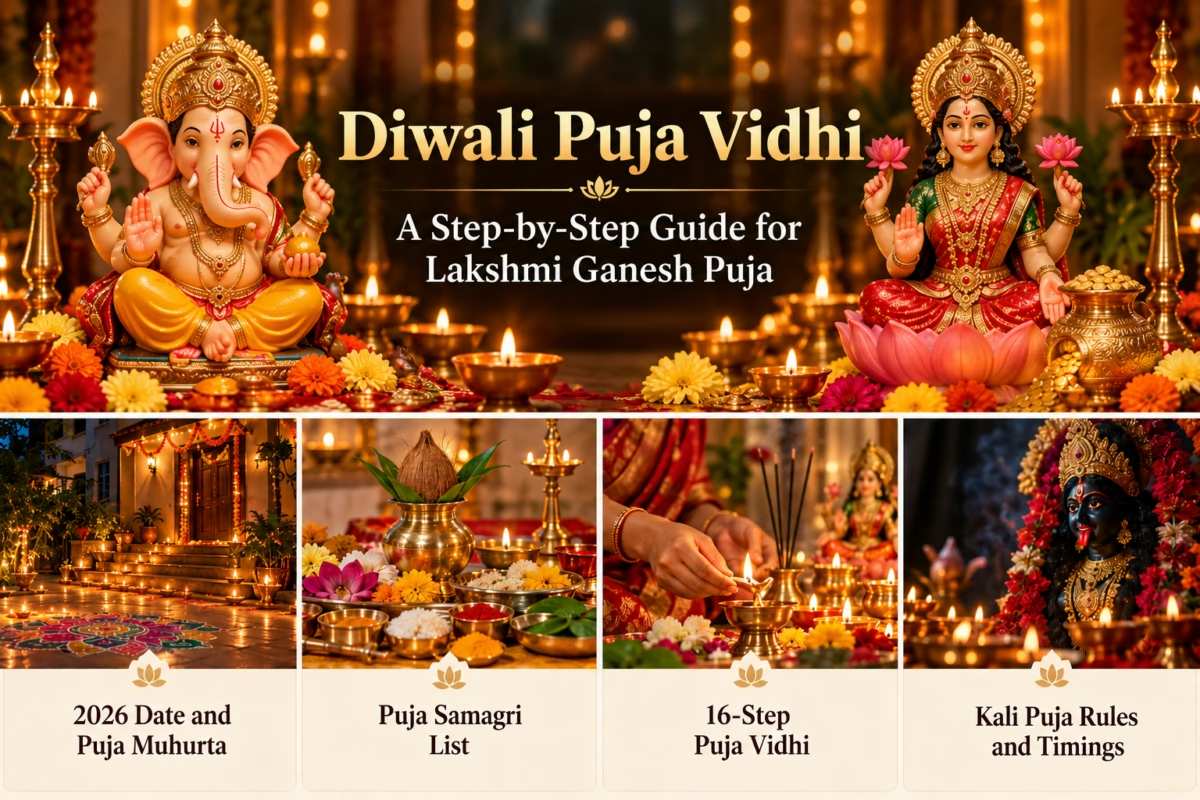
Diwali Puja Vidhi is the step-by-step worship of Goddess Lakshmi (Laxmi) and Lord Ganesh on the Amavasya night of Kartika. It is performed in Pradosh Kaal, after sunset. In 2026, Diwali (Deepavali) falls on Sunday, 8 November, and the Delhi Lakshmi Puja muhurta is 5:54 PM to 7:50 PM. In Bengal, Assam, and Odisha, the same night is Kali Puja, kept at midnight. This guide gives city-wise muhurtas, the samagri list, and 16 pooja steps with traditional mantras.
| Term | Meaning |
|---|---|
| Amavasya | The new moon night; Diwali falls on the Amavasya of Kartika, called Ashvina in the Amanta calendar |
| Pradosh Kaal | The first fifth of the night after sunset; the time the texts set for Lakshmi Puja |
| Vrishabha Kaal | The period when Taurus, a fixed sign, is rising; the preferred evening puja window |
| Nishita Kaal | The eighth of the fifteen divisions of the night, around midnight; the time of Kali Puja |
| Kalaratri | “The Night of Time”: tradition’s name for Diwali night, the darkest of four great nights of worship |
| Kali Puja | The midnight worship of Kali on Diwali Amavasya in Bengal, Assam, Tripura, and Odisha |
| Kalash | The consecrated water pot that holds the gods of the puja; Lakshmi is seated on its lid |
| Shodashopachara | The sixteen services offered to a deity as an honoured guest, from seat to aarti |
| Sankalpa | The spoken vow naming who performs the puja, where, when, and for what |
| Chopda Pujan | The worship of new account books by traders on Diwali |
Diwali Puja Vidhi at a Glance
Diwali puja is the worship of Goddess Lakshmi and Lord Ganesh on the new moon night (amāvasyā) of Kartika, also called Ashvina in the Amanta calendar used in Gujarat, Maharashtra, and South India. It is performed after sunset, in the window called Pradosh Kaal. In 2026, Diwali falls on Sunday, 8 November, and the Lakshmi Puja muhurta in Delhi is 5:54 PM to 7:50 PM. Families invite Lakshmi, the goddess of wealth, into a clean, lamp-lit home and worship Ganesh first so the year ahead begins without obstacles.
This guide includes the 2026 muhurta for India, the Netherlands, Australia, and the United States; the full samagri list; the 16-step puja with the traditional mantra for each step; and Kali Puja rules and timings for families in Bengal, Assam, and Odisha.
Diwali 2026 Date and Lakshmi Puja Muhurta
Diwali 2026 is on Sunday, 8 November. Amavasya begins at 11:27 AM on 8 November and ends at 12:31 PM on 9 November (IST). It therefore covers Pradosh Kaal on the evening of 8 November, which makes that evening the night of Lakshmi Puja in India, the Netherlands, Australia, and the United States. The governing rule is that Amavasya must prevail during Pradosh Kaal; the festival date follows that overlap, not the calendar day on which the tithi begins.
Delhi (IST)
| Muhurta | Time |
|---|---|
| Lakshmi Puja muhurta (Pradosh Kaal) | 5:54 PM to 7:50 PM (1 hour 56 minutes) |
| Pradosh Kaal | 5:31 PM to 8:09 PM |
| Vrishabha Kaal | 5:54 PM to 7:50 PM |
| Lakshmi Puja muhurta (Nishita Kaal) | 11:39 PM to 12:31 AM, 9 November (52 minutes) |
| Mahanishita Kaal | 11:39 PM to 12:31 AM, 9 November |
| Simha Kaal | 12:25 AM to 2:42 AM, 9 November |
| Amavasya | 11:27 AM, 8 November to 12:31 PM, 9 November |
Auspicious Choghadiya in Delhi: morning (Chara, Labha, and Amrita) 11:27 AM to 12:05 PM; afternoon (Shubha) 1:26 PM to 2:48 PM; evening (Shubha, Amrita, and Chara) 5:31 PM to 10:27 PM; night (Labha) 1:43 AM to 3:22 AM, 9 November; early morning (Shubha) 5:00 AM to 6:39 AM, 9 November.
Netherlands (Amsterdam)
Outside India, muhurta windows depend on each city’s sunset and rising sign, so we calculate them separately for each city, not by converting from Delhi time.
| Muhurta | Time (CET) |
|---|---|
| Lakshmi Puja muhurta (Pradosh Kaal) | 5:11 PM to 6:48 PM (1 hour 37 minutes) |
| Pradosh Kaal | 4:59 PM to 7:57 PM |
| Vrishabha Kaal | 5:11 PM to 6:48 PM |
| Lakshmi Puja muhurta (Nishita Kaal) | 11:55 PM to 12:54 AM, 9 November |
| Simha Kaal | 12:02 AM to 2:54 AM, 9 November |
| Amavasya | 6:57 AM, 8 November to 8:01 AM, 9 November |
Australia
In Australia, Vrishabha lagna runs past the end of Pradosh Kaal, so the puja window closes when Pradosh Kaal ends.
| City | Lakshmi Puja muhurta | Pradosh Kaal | Vrishabha Kaal | Nishita muhurta |
|---|---|---|---|---|
| Sydney, NSW (AEDT) | 8:05 PM to 9:33 PM | 7:29 PM to 9:33 PM | 8:05 PM to 10:27 PM | 12:18 AM to 12:59 AM, 9 November |
| Melbourne, VIC (AEDT) | 8:39 PM to 10:03 PM | 8:02 PM to 10:03 PM | 8:39 PM to 11:02 PM | 12:44 AM to 1:24 AM, 9 November |
| Brisbane, QLD (AEST) | 6:46 PM to 8:19 PM | 6:11 PM to 8:19 PM | 6:46 PM to 9:04 PM | 11:10 PM to 11:53 PM, 8 November |
| Adelaide, SA (ACDT) | 8:28 PM to 9:55 PM | 7:52 PM to 9:55 PM | 8:28 PM to 10:50 PM | 12:39 AM to 1:20 AM, 9 November |
| Perth, WA (AWST) | 7:22 PM to 8:53 PM | 6:47 PM to 8:53 PM | 7:22 PM to 9:43 PM | 11:39 PM, 8 November to 12:21 AM, 9 November |
Amavasya in local time: Sydney and Melbourne 4:57 PM, 8 November to 6:01 PM, 9 November; Brisbane 3:57 PM to 5:01 PM; Adelaide 4:27 PM to 5:31 PM; Perth 1:57 PM to 3:01 PM.
United States
| City | Lakshmi Puja muhurta | Pradosh Kaal | Vrishabha Kaal | Nishita muhurta |
|---|---|---|---|---|
| New York City (EST) | 5:03 PM to 6:51 PM | 4:44 PM to 7:31 PM | 5:03 PM to 6:51 PM | 11:12 PM to 12:08 AM, 9 November |
| Miami, Florida (EST) | 5:58 PM to 7:55 PM | 5:35 PM to 8:11 PM | 5:58 PM to 7:55 PM | 11:39 PM to 12:31 AM, 9 November |
| Los Angeles, California (PST) | 5:14 PM to 7:07 PM | 4:54 PM to 7:35 PM | 5:14 PM to 7:07 PM | None |
| San Francisco, California (PST) | 5:23 PM to 7:13 PM | 5:04 PM to 7:48 PM | 5:23 PM to 7:13 PM | None |
| Seattle, Washington (PST) | 4:56 PM to 6:38 PM | 4:41 PM to 7:34 PM | 4:56 PM to 6:38 PM | None |
Amavasya in local time: Eastern 12:57 AM, 8 November to 2:01 AM, 9 November; Pacific 9:57 PM, 7 November to 11:01 PM, 8 November. On the West Coast, Amavasya ends before midnight, so there is no Nishita muhurta; perform the puja in Pradosh Kaal.
Auspicious Choghadiya Outside India
| City | Daytime, 8 November | Evening, 8 November | Night to dawn, 9 November |
|---|---|---|---|
| Amsterdam | 8:58 AM to 12:24 PM; 1:33 PM to 2:41 PM | 4:59 PM to 10:33 PM | 2:16 AM to 4:08 AM; 5:59 AM to 7:51 AM |
| Sydney | None (Amavasya begins 4:57 PM) | 7:29 PM to 11:21 PM | 1:56 AM to 3:13 AM; 4:31 AM to 5:48 AM |
| Melbourne | None | 8:02 PM to 11:48 PM | 2:19 AM to 3:35 AM; 4:50 AM to 6:05 AM |
| Brisbane | None | 6:11 PM to 10:11 PM | 12:52 AM to 2:12 AM; 3:32 AM to 4:52 AM |
| Adelaide | None | 7:52 PM to 11:42 PM | 2:16 AM to 3:33 AM; 4:50 AM to 6:06 AM |
| Perth | 1:57 PM to 3:24 PM | 6:47 PM to 10:42 PM | 1:18 AM to 2:36 AM; 3:55 AM to 5:13 AM |
| New York City | 7:51 AM to 11:40 AM; 12:56 PM to 2:12 PM | 4:44 PM to 9:56 PM | 1:24 AM to 2:01 AM |
| Miami | 7:56 AM to 12:04 PM; 1:27 PM to 2:50 PM | 5:35 PM to 10:27 PM | 1:42 AM to 2:01 AM |
| Los Angeles | 7:39 AM to 11:37 AM; 12:56 PM to 2:15 PM | 4:54 PM to 9:56 PM | None |
| San Francisco | 8:00 AM to 11:53 AM; 1:11 PM to 2:29 PM | 5:04 PM to 10:11 PM | None |
| Seattle | 8:16 AM to 11:53 AM; 1:05 PM to 2:17 PM | 4:41 PM to 10:05 PM | None |
The evening window is Shubha, Amrita, and Chara in a row; the night window is Labha; the dawn window is Shubha. Daytime windows are Chara, Labha, and Amrita in the morning and Shubha in the afternoon.
Why Lakshmi and Ganesh Are Worshipped Together
Goddess Lakshmi is the giver of wealth, fortune, and abundance (śrī), and Diwali night is her night: tradition holds that she visits clean, lit, welcoming homes. In almost every Hindu rite, people worship Lord Ganesh first as the remover of obstacles (vighnahartā) and the lord of beginnings, so the new financial year starts on a clear path.
The pairing also carries a lesson. Lakshmi is called restless (cañcalā) because wealth does not stay on its own; Ganesh is the lord of wisdom (buddhi). Worshipped together, they ask for wealth with the wisdom to use it well. That is why Ganesh sits beside Lakshmi on the altar and receives worship before her.
Kali Puja: Diwali Night as Kalaratri
In Bengal, Assam, Tripura, Odisha, Bangladesh, and the Anga region of Bihar, devotees worship Kali on this Amavasya at midnight as Shyama or Dakshina Kali. Bengal, Assam, Tripura, and Bangladesh celebrate Lakshmi Puja a fortnight earlier, on Kojagari Purnima; in Odisha and Bihar, families practice it differently. The two are not rival festivals. The Durga Saptashati names the Goddess herself as the night:
प्रकृतिस्त्वं च सर्वस्य गुणत्रयविभाविनी।
कालरात्रिर्महारात्रिर्मोहरात्रिश्च दारुणा॥prakṛtis tvaṁ ca sarvasya guṇatrayavibhāvinī |
kālarātrir mahārātrir moharātriś ca dāruṇā ||“You are the primordial nature of all, who brings forth the three qualities; you are the Night of Time, the Great Night, and the terrible Night of Delusion.” (Durgā Saptaśatī 1.78)
Tradition reads the Night of Time (kālarātri) as this Amavasya, the darkest of the year, and the goddess of that night is Kali; her name and the night share the word kāla, time. North and West India worship the Goddess as Lakshmi on this night; the East worships her as Kali. Even the North Indian vidhi keeps Kali in it, in the pen and ink worshipped as Mahakali (Step 10), and at Kalighat in Kolkata, Kali is worshipped as Lakshmi on this night.
The Midnight Rule
Lakshmi Puja needs Amavasya during Pradosh Kaal; Kali Puja needs Amavasya at midnight, in Nishita Kaal. In most years, both fall on the same night. When Amavasya begins late in the evening, Kali Puja falls a day before Lakshmi Puja. In 2026, Amavasya covers both Pradosh and midnight on 8 November, so Kali Puja and Lakshmi Puja fall on the same night.
| City | Kali Puja (Nishita), night of 8 November 2026 (IST) |
|---|---|
| Kolkata | 10:55 PM to 11:46 PM |
| Guwahati | 10:40 PM to 11:32 PM |
| Bhubaneswar | 11:05 PM to 11:56 PM |
| Delhi | 11:39 PM to 12:31 AM, 9 November |
Kali in the Household
The image explains the worship. Kali stands on Shiva with her tongue out, wearing a garland of severed heads, traditionally fifty, which the tradition reads as the fifty letters of the Sanskrit alphabet: she is sound itself, the source of every word. Bengal tells how the image got its tongue. Krishnananda Agamavagisha of Nabadwip prayed to know her form and was told to follow the first person he saw at dawn. He saw a village woman shaping cow-dung cakes; when she noticed him, she bit her tongue in shame, and that is the Dakshina Kali on every Bengali altar.
Priests worship the great images in pandals and temples, sometimes with Tantric rites. The household worship is plain. Red hibiscus (jabā) is her flower, offered singly or strung into a 108-flower garland; lamps are lit in every room, and the food offered includes rice, lentils, sweets, and fruit. A household that has not received initiation worships her with the name mantra ॐ श्रीकालीदेव्यै नमः (Oṁ śrīkālīdevyai namaḥ). Her seed syllables and the longer Dakshina Kali mantra are traditionally received from a guru through initiation (dīkṣā), not chanted from a page.
How Kali Puja Came to Bengal
Kali appears in Bengali devotional poetry by the 17th century. Krishnananda Agamavagisha, author of the Brihat Tantrasara, is credited with fixing the Dakshina Kali image and bringing her worship into the household; his dates are uncertain, placed between the 16th and 17th centuries. In the 18th century, Raja Krishnachandra of Nadia made the puja a public festival, and Ramprasad Sen’s songs made Kali the mother of Bengali devotion. In the 19th century, Sri Ramakrishna’s worship at Dakshineswar carried it into every Bengali home.
How India Worships Diwali Night
The same Amavasya sees different worship across India, and families abroad usually keep the customs of their region of origin.
| Region | Deity of the night | Distinctive rite | When Lakshmi is worshipped |
|---|---|---|---|
| North and Central India | Lakshmi and Ganesh, with Kuber | Puja in Pradosh Kaal; ledger, pen and ink, and scales worshipped; lamps all night | Diwali Amavasya |
| Gujarat | Lakshmi, with Sarasvati in the ledgers | Chopda or Sharda Pujan; Bestu Varas, the new year, on the next day | Diwali Amavasya |
| Maharashtra | Lakshmi | Lakshmi Pujan in the evening; Bali Pratipada (Padwa) on the next day | Diwali Amavasya |
| Bengal, Assam, Tripura, and Bangladesh | Kali (Shyama) | Midnight Kali Puja; lamps on every ledge and roof | Kojagari Purnima, a fortnight earlier |
| Odisha | Kali, with Lakshmi in some homes | Bada Badua Daka: burning jute sticks call the ancestors to the light | Kojagari Purnima |
| Bihar (Anga region) | Kali | Kali Puja at night | Varies by family |
| Tamil Nadu and much of the South | Lakshmi and Kubera in some families | Deepavali is kept at dawn on Naraka Chaturdashi, with the oil bath | Amavasya, in families that keep it |
Odia families call to their ancestors as they burn jute sticks (kaunria kāṭhi): “Bada badua ho, andhaara re aasa, alua re jaa”, “O ancestors, come in the darkness, go into the light.”
The Five Days of Diwali
Diwali is a five-day festival, and Lakshmi Puja on the third day is its centre.
| Day | Festival | Date (2026, India) | What is done |
|---|---|---|---|
| 1 | Dhanteras (Dhanatrayodashi) | Friday, 6 November | Buying gold, silver, or new utensils; a lamp for Yama at the door; worship of Dhanvantari and Kuber |
| 2 | Narak Chaturdashi (Chhoti Diwali) | Lamps: Saturday, 7 November; oil bath: before sunrise, Sunday, 8 November | Early oil bath (abhyaṅga snāna); lamps to dispel darkness |
| 3 | Lakshmi Puja (Diwali) | Sunday, 8 November | Lakshmi Ganesh puja in Pradosh Kaal; Kali Puja at midnight in the East; lamps through the night |
| 4 | Govardhan Puja (Annakut) | Tuesday, 10 November | Worship of Govardhan and Krishna; offering of many foods. In Gujarat, this day (Kartika Shukla Pratipada) is Bestu Varas, the Gujarati New Year |
| 5 | Bhai Dooj | Wednesday, 11 November | Sisters pray for their brothers’ long life; brothers give gifts |
In 2026, the five days don’t fall on five consecutive dates because each festival follows its own tithi rule. Chaturdashi runs from 10:47 AM on 7 November to 11:27 AM on 8 November (IST): it covers the evening of the 7th, when the Chaturdashi lamps are lit, but is present before sunrise only on the 8th, so the Narak Chaturdashi bath and Lakshmi Puja fall on the same day. Pratipada begins only at 12:31 PM on 9 November, so Govardhan Puja and Bestu Varas, which need Pratipada at sunrise, move to the 10th. Monday, 9 November, carries no festival of the five. Dates follow Drik Panchang for India; families abroad should check a panchang for their own city.
Preparing for the Puja
Preparation begins days before Diwali, because Lakshmi is said to enter only a clean home.
The Shri Suktam names the purpose of the cleaning. Before Lakshmi is invited, her elder sister Alakshmi (Alakṣmī), the goddess of ill fortune, has to leave, and the hymn describes her plainly as hunger, thirst, and grime:
क्षुत्पिपासामलां ज्येष्ठामलक्ष्मीं नाशयाम्यहम्।
अभूतिमसमृद्धिं च सर्वां निर्णुद मे गृहात्॥kṣutpipāsāmalāṁ jyeṣṭhām alakṣmīṁ nāśayāmy aham |
abhūtim asamṛddhiṁ ca sarvāṁ nirṇuda me gṛhāt ||“I destroy Alakṣmī, the elder, who is hunger, thirst, and grime. Drive out from my house all ill fortune and want.” (Śrī Sūkta, v. 8)
In the household reading of this verse, Alakshmi lives wherever things are left undone: dust behind the cupboard, a dripping tap, last night’s vessels still in the sink. The broom is therefore the first act of the puja. Once Lakshmi has been invited, put the broom away, which is why the house isn’t swept after the puja.
Clean and declutter the whole house in the days before, and on Diwali morning sprinkle Gangajal in every room.
Decorate the entrance with a rangoli and a toran of mango leaves and marigolds, and draw Lakshmi’s footprints walking into the house in rice paste or kumkum.
Choose the place: set up the altar in the north-east of the puja room or living room so you face east or north while you worship.
Buy new items for the year: account books, a pen, and new idols or pictures that the family replaces each Diwali.
Diwali Puja Samagri List
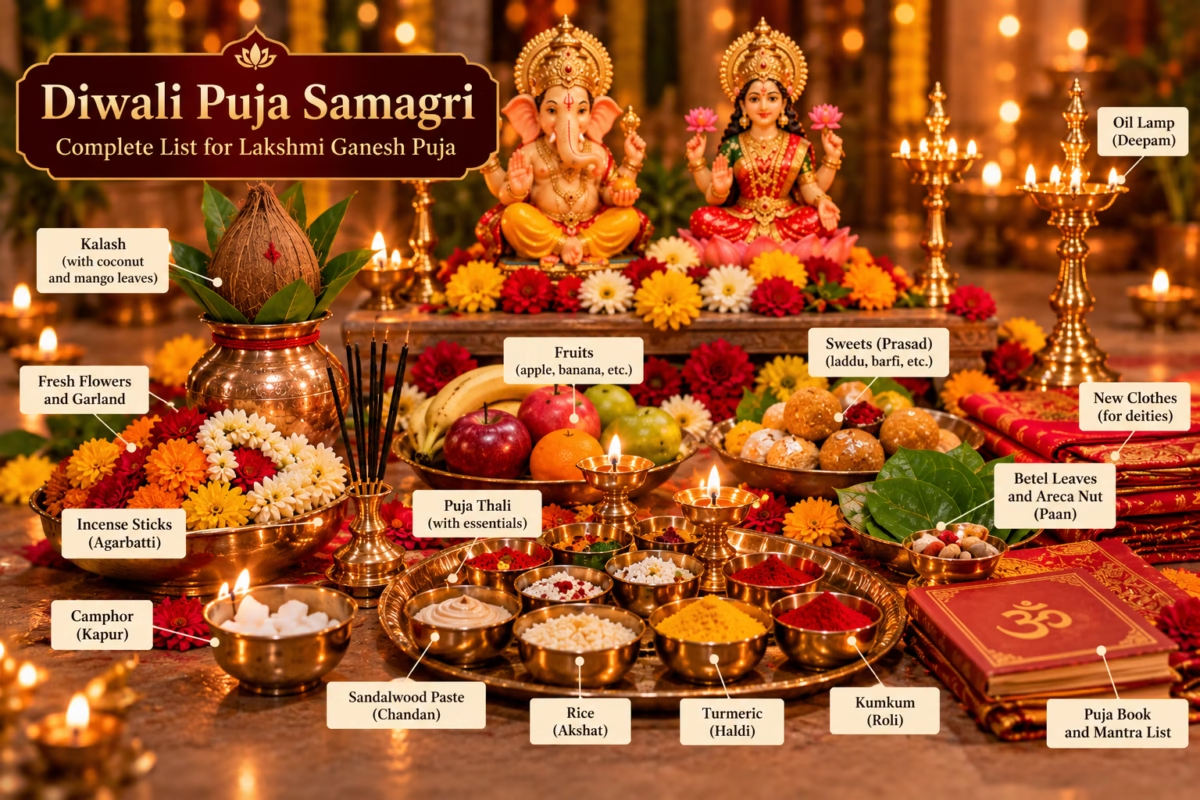
Gather all of these before the muhurta begins.
| Group | Items |
|---|---|
| Altar | Idols or pictures of Lord Ganesh and Goddess Lakshmi; a low wooden stool (paṭṭā); new red or yellow cloth; a plate (thālī) |
| For Lakshmi | A red chunari or cloth; bangles or a small ornament |
| Kalash | One earthen, copper, or silver pot with lid; five mango leaves; one coconut; one betel nut; durva grass; one coin; Gangajal |
| Puja items | Kumkum, turmeric, and sandalwood powder (one spoon each); unbroken rice (akṣata), one cup; kalawa (red sacred thread); two janeu (white sacred thread), one for Ganesh and one for the Kalash; a bell; a pañcapātra and spoon for achamana |
| Flowers | One lotus, and roses or marigolds; two garlands; red hibiscus for Kali Puja |
| Lamps and fragrance | Two large and nine small earthen diyas, plus 11, 21, or more for the row of lamps; cotton wicks; desi ghee and mustard or sesame oil; incense sticks and dhoop; camphor |
| Panchamrit | Raw milk, curd, and ghee (one cup each); honey (two spoons); sugar (one cup) |
| Offerings | Five kinds of fruit; sweets; home-cooked prasad; betel leaves and betel nuts; coins for dakshina |
| Work and wealth | A new pen and inkpot; account books or ledger; the cash box or safe; a weighing scale or the tools of your work; five or seven gold or silver coins (one is enough); currency notes |
| Havan (optional) | A havan kund; samidha wood; ghee |
Diwali Puja Vidhi: Step-by-Step Guide
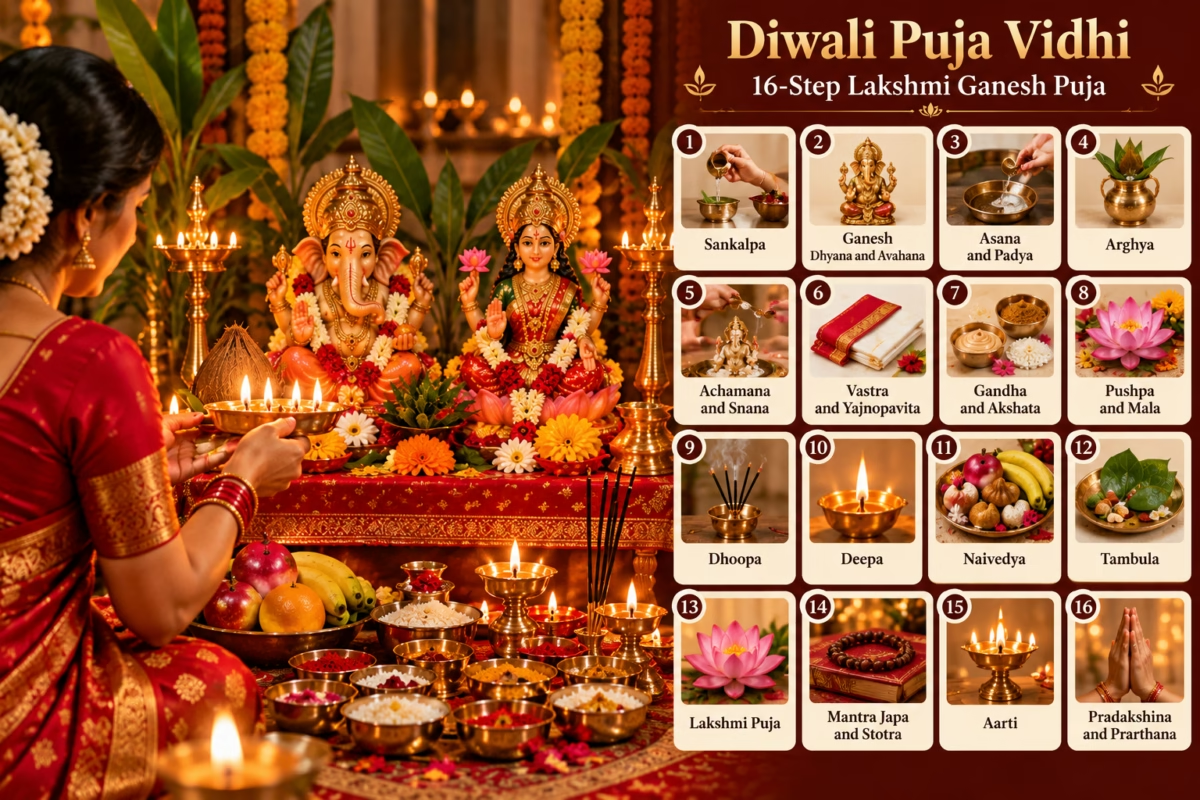
The full puja takes about ninety minutes; begin within the muhurta for your city. The household manuals (paddhati) set the order: purification, Ganesh, the Kalash and the planets, the sixteen services to Lakshmi, then the worships proper to Diwali night (the threshold, the pen and ink as Mahakali, the ledger, the scales, and the row of lamps), and last the aarti and the prayer for forgiveness.
Step 1: Purify the space and yourself
Clean the puja room or corner once more just before you start. Sprinkle a little Gangajal in each corner, at the centre of the room, and on yourself, reciting the purification verse (pavitrīkaraṇa):
Purification verse (pavitrīkaraṇa)
ॐ अपवित्रः पवित्रो वा सर्वावस्थां गतोऽपि वा।
यः स्मरेत् पुण्डरीकाक्षं स बाह्याभ्यन्तरः शुचिः॥
Oṁ apavitraḥ pavitro vā sarvāvasthāṁ gato’pi vā |
yaḥ smaret puṇḍarīkākṣaṁ sa bāhyābhyantaraḥ śuciḥ ||
Meaning: Whether impure or pure, in whatever state one may be, whoever remembers the lotus-eyed Lord is clean without and within.
Step 2: Set up the altar, the Kalash, and the idols
Place the stool in the north-east corner. With kumkum, draw a swastika at its centre; write “Shubh” to its left and “Labh” to its right; cover it with a red cloth, and place a handful of grains in the centre.
Set the Kalash on the grains, mark it with a swastika or “Om”, and tie kalawa around its neck. Fill it three-quarters full with water, then add a betel nut, a flower, a little scent, durva grass, a coin, and some akshata. Arrange five mango leaves around its mouth, half in and half out, and close the lid. Place Lord Ganesh on the left side of the Kalash as you face the altar. Make a small bed of rice on the Kalash lid, draw a lotus on it with turmeric, and seat Goddess Lakshmi on it, with the coins and the lotus before her. Light two large diyas, one with ghee and one with mustard or sesame oil, and let them burn throughout the puja.
Step 3: Worship Dehali Vinayak at the main door
Worship the threshold before calling Lakshmi in. On the main door, draw a swastika in kumkum with “Shubh” and “Labh” on either side; this mark is Dehali Vinayak, Ganesh as guardian of the threshold (dehalī). Offer it kumkum, a flower, incense, a lamp, and a sweet, each with ॐ देहलीविनायकाय नमः (Oṁ dehalīvināyakāya namaḥ) followed by the formula for that offering in the table at Step 9.
Step 4: Take achamana and the sankalpa
Sit facing east or north. Sip a little water from the panchapatra three times (ācamana), once with each name: ॐ केशवाय नमः, ॐ नारायणाय नमः, ॐ माधवाय नमः (Oṁ keśavāya namaḥ, Oṁ nārāyaṇāya namaḥ, Oṁ mādhavāya namaḥ). Wash the right hand with ॐ हृषीकेशाय नमः (Oṁ hṛṣīkeśāya namaḥ), and touch water to your eyes, ears, and lips. Then hold water, akshata, and a flower in your right palm; begin with ॐ विष्णुर्विष्णुर्विष्णुः (Oṁ viṣṇur viṣṇur viṣṇuḥ); and state your name, gotra, place, date, and wish for the year (saṅkalpa). Release them onto the plate.
Step 5: Worship Lord Ganesh first
Apply a tilak of kumkum and sandalwood to Ganesh, and offer the first janeu, durva grass, a flower, and a sweet. Pray with the Vakratunda verse, then chant the Ganesh mantra from the Mantras section:
Prayer to Ganesh
वक्रतुण्ड महाकाय सूर्यकोटिसमप्रभ।
निर्विघ्नं कुरु मे देव सर्वकार्येषु सर्वदा॥
vakratuṇḍa mahākāya sūryakoṭisamaprabha |
nirvighnaṁ kuru me deva sarvakāryeṣu sarvadā ||
Meaning: O curved-trunked one of great body, radiant as ten million suns: O Lord, make all my undertakings free of obstacles, always.
No worship of Lakshmi begins before this.
Step 6: Worship the Kalash
Offer the second janeu to the Kalash, call Varuna, lord of the waters, into it with ॐ वरुणाय नमः (Oṁ varuṇāya namaḥ), touch it with your right hand, and recite the Kalash verse:
Kalash verse
कलशस्य मुखे विष्णुः कण्ठे रुद्रः समाश्रितः।
मूले त्वस्य स्थितो ब्रह्मा मध्ये मातृगणाः स्मृताः॥
kalaśasya mukhe viṣṇuḥ kaṇṭhe rudraḥ samāśritaḥ |
mūle tvasya sthito brahmā madhye mātṛgaṇāḥ smṛtāḥ ||
Meaning: Vishnu dwells in the mouth of the Kalash and Rudra in its neck; Brahma stands at its base, and the Mothers are remembered in its middle.
Step 7: Worship the nine planets
Light the nine small diyas for the nine planets (navagraha) and recite the Navagraha verse before them:
Navagraha verse
ब्रह्मा मुरारिस्त्रिपुरान्तकारी भानुः शशी भूमिसुतो बुधश्च।
गुरुश्च शुक्रः शनिराहुकेतवः सर्वे ग्रहाः शान्तिकरा भवन्तु॥
brahmā murāris tripurāntakārī bhānuḥ śaśī bhūmisuto budhaś ca |
guruś ca śukraḥ śanirāhuketavaḥ sarve grahāḥ śāntikarā bhavantu ||
Meaning: Brahma, Murari, and the destroyer of Tripura; the Sun, the Moon, the son of the Earth, and Mercury; Jupiter, Venus, Saturn, Rahu, and Ketu: may all the planets bring peace.
Step 8: Meditate on and invoke Goddess Lakshmi
Sit before the image and hold her form in mind with the meditation verse (dhyāna):
Meditation on Lakshmi (dhyāna)
या सा पद्मासनस्था विपुलकटितटी पद्मपत्रायताक्षी।
गम्भीरावर्तनाभिः स्तनभरनमिता शुभ्रवस्त्रोत्तरीया॥
या लक्ष्मीर्दिव्यरूपैर्मणिगणखचितैः स्नापिता हेमकुम्भैः।
सा नित्यं पद्महस्ता मम वसतु गृहे सर्वमाङ्गल्ययुक्ता॥
yā sā padmāsanasthā vipulakaṭitaṭī padmapatrāyatākṣī |
gambhīrāvartanābhiḥ stanabharanamitā śubhravastrottarīyā ||
yā lakṣmīr divyarūpair maṇigaṇakhacitaiḥ snāpitā hemakumbhaiḥ |
sā nityaṁ padmahastā mama vasatu gṛhe sarvamāṅgalyayuktā ||
Meaning: Lakshmi, seated on the lotus, broad-hipped, her eyes long as lotus petals, deep-navelled, bowed by the fullness of her breasts, in a white upper garment, bathed from golden pitchers set with jewels: may she, lotus in hand, dwell always in my house, with every blessing.
Then join the palms with the thumbs folded in (āvāhana mudrā) and call her into the image:
Invocation of Lakshmi (āvāhana)
आगच्छ देवि देवेशि तेजोमयि महालक्ष्मि।
क्रियमाणां मया पूजां गृहाण सुरवन्दिते॥
॥ श्रीलक्ष्मीदेवीम् आवाहयामि ॥
āgaccha devi deveśi tejomayi mahālakṣmi |
kriyamāṇāṁ mayā pūjāṁ gṛhāṇa suravandite ||
śrīlakṣmīdevīm āvāhayāmi
Meaning: Come, Goddess, queen of the gods, radiant Mahalakshmi; accept the worship I offer, you whom the gods adore. I invoke Shri Lakshmi.
Families who chant the Vedic hymn invoke her instead, or as well, with the first verse of the Shri Suktam, which asks Agni, the knower of all beings (Jātavedas), to bring her:
Śrī Sūkta, first verse
हिरण्यवर्णां हरिणीं सुवर्णरजतस्रजाम्।
चन्द्रान् हिरण्मयीं लक्ष्मीं जातवेदो म आवह॥
hiraṇyavarṇāṁ hariṇīṁ suvarṇarajatasrajām |
candrāṁ hiraṇmayīṁ lakṣmīṁ jātavedo ma āvaha ||
Meaning: O Jātavedas, bring to me Lakṣmī, golden in colour, the doe, wearing garlands of gold and silver, moon-like and golden.” (Śrī Sūkta, v. 1)
Step 9: Offer the services, with their verses
The services (upacāra) receive the goddess as an honoured guest who has just arrived. Their core is sixteen (ṣoḍaśopacāra), and the fuller manuals expand them; Drik Panchang’s sequence for a new Lakshmi image runs to 34 numbered steps, which the services below and the paragraph after them follow. Recite each verse as you make the offering, then say its closing formula. Ganesh receives the same services first, with ॐ गणेशाय नमः (Oṁ gaṇeśāya namaḥ) in place of Lakshmi’s name.
1. Seat (āsana). Offer five flowers from cupped hands.
नानारत्नसमायुक्तं कार्तस्वरविभूषितम्।
आसनं देवि देवेशि प्रीत्यर्थं प्रतिगृह्यताम्॥
॥ श्रीलक्ष्मीदेव्यै आसनार्थे पञ्चपुष्पाणि समर्पयामि ॥nānāratnasamāyuktaṁ kārtasvaravibhūṣitam |
āsanaṁ devi deveśi prītyarthaṁ pratigṛhyatām ||
śrīlakṣmīdevyai āsanārthe pañcapuṣpāṇi samarpayāmi2. Welcome (svāgata). With folded hands:
श्रीलक्ष्मीदेवि स्वागतम्।
śrīlakṣmīdevi svāgatam
3. Feet (pādya). Offer water at her feet.
पाद्यं गृहाण देवेशि सर्वक्षेमसमर्थे भोः।
भक्त्या समर्पितं देवि महालक्ष्मि नमोऽस्तु ते॥
॥ श्रीलक्ष्मीदेव्यै नमः पाद्यं समर्पयामि ॥pādyaṁ gṛhāṇa deveśi sarvakṣemasamarthe bhoḥ |
bhaktyā samarpitaṁ devi mahālakṣmi namo’stu te ||
śrīlakṣmīdevyai namaḥ pādyaṁ samarpayāmi4. Head (arghya). Offer water with sandalwood, a flower, and rice.
नमस्ते देवि देवेशि नमस्ते कमलधारिणि।
गृहाणार्घ्यं मया दत्तं महालक्ष्मि नमोऽस्तु ते॥
गन्धपुष्पाक्षतैर्युक्तं फलद्रव्यसमन्वितम्।
गृहाण तोयमर्घ्यार्थं परमेश्वरि वत्सले॥
॥ श्रीलक्ष्मीदेव्यै नमः अर्घ्यं समर्पयामि ॥namaste devi deveśi namaste kamaladhāriṇi |
gṛhāṇārghyaṁ mayā dattaṁ mahālakṣmi namo’stu te ||
gandhapuṣpākṣatair yuktaṁ phaladravyasamanvitam |
gṛhāṇa toyam arghyārthaṁ parameśvari vatsale ||
śrīlakṣmīdevyai namaḥ arghyaṁ samarpayāmi5. Bath. Bathe the image with water, reciting the bath verse and Shri Suktam verse 6.
गङ्गासरस्वतीरेवापयोष्णीनर्मदाजलैः।
स्नापितासि मया देवि तथा शान्तिं कुरुष्व मे॥
आदित्यवर्णे तपसोऽधिजातो वनस्पतिस्तव वृक्षोऽथ बिल्वः।
तस्य फलानि तपसा नुदन्तु मायान्तरायाश्च बाह्या अलक्ष्मीः॥
॥ श्रीलक्ष्मीदेव्यै नमः जलस्नानं समर्पयामि ॥gaṅgāsarasvatīrevāpayoṣṇīnarmadājalaiḥ |
snāpitāsi mayā devi tathā śāntiṁ kuruṣva me ||
ādityavarṇe tapaso’dhijāto vanaspatis tava vṛkṣo’tha bilvaḥ |
tasya phalāni tapasā nudantu māyāntarāyāś ca bāhyā alakṣmīḥ ||
śrīlakṣmīdevyai namaḥ jalasnānaṁ samarpayāmi6. Five-nectar bath (pañcāmṛta snāna). Bathe the image with panchamrit.
दधि मधु घृतञ्चैव पयश्च शर्करायुतम्।
पञ्चामृतं समानीतं स्नानार्थं प्रतिगृह्यताम्॥
ॐ पञ्च नद्यः सरस्वतीमपि यन्ति सस्रोतसः।
सरस्वती तु पञ्चधा सो देशेऽभवत्सरित्॥
॥ श्रीलक्ष्मीदेव्यै नमः पञ्चामृतस्नानं समर्पयामि ॥dadhi madhu ghṛtañ caiva payaś ca śarkarāyutam |
pañcāmṛtaṁ samānītaṁ snānārthaṁ pratigṛhyatām ||
oṁ pañca nadyaḥ sarasvatīm api yanti sasrotasaḥ |
sarasvatī tu pañcadhā so deśe’bhavat sarit ||
śrīlakṣmīdevyai namaḥ pañcāmṛtasnānaṁ samarpayāmi7. Fragrant bath (gandha snāna). Bathe the image with water mixed with sandalwood.
ॐ मलयाचलसम्भूतं चन्दनागरुसम्भवम्।
चन्दनं देवि देवेशि स्नानार्थं प्रतिगृह्यताम्॥
॥ श्रीलक्ष्मीदेव्यै नमः गन्धस्नानं समर्पयामि ॥oṁ malayācalasambhūtaṁ candanāgarusambhavam |
candanaṁ devi deveśi snānārthaṁ pratigṛhyatām ||
śrīlakṣmīdevyai namaḥ gandhasnānaṁ samarpayāmi8. Pure bath (śuddha snāna). Bathe the image with clean water, then wipe it dry.
मन्दाकिन्यास्तु यद्वारि सर्वपापहरं शुभम्।
तदिदं कल्पितं तुभ्यं स्नानार्थं प्रतिगृह्यताम्॥
॥ श्रीलक्ष्मीदेव्यै नमः शुद्धोदकस्नानं समर्पयामि ॥mandākinyās tu yad vāri sarvapāpaharaṁ śubham |
tad idaṁ kalpitaṁ tubhyaṁ snānārthaṁ pratigṛhyatām ||
śrīlakṣmīdevyai namaḥ śuddhodakasnānaṁ samarpayāmi9. Clothing (vastra). Offer the red cloth, or kalawa, with the clothing verse and Shri Suktam verse 7.
दिव्याम्बरं नूतनं हि क्षौमं त्वतिमनोहरम्।
दीयमानं मया देवि गृहाण जगदम्बिके॥
उपैतु मां देवसखः कीर्तिश्च मणिना सह।
प्रादुर्भूतोऽस्मि राष्ट्रेऽस्मिन् कीर्तिमृद्धिं ददातु मे॥
॥ श्रीलक्ष्मीदेव्यै नमः वस्त्रं समर्पयामि ॥divyāmbaraṁ nūtanaṁ hi kṣaumaṁ tv atimanoharam |
dīyamānaṁ mayā devi gṛhāṇa jagadambike ||
upaitu māṁ devasakhaḥ kīrtiś ca maṇinā saha |
prādurbhūto’smi rāṣṭre’smin kīrtim ṛddhiṁ dadātu me ||
śrīlakṣmīdevyai namaḥ vastraṁ samarpayāmi10. Honey and curd (madhuparka). Offer curd mixed with honey.
ॐ कापिलं दधि कुन्देन्दुधवलं मधुसंयुतम्।
स्वर्णपात्रस्थितं देवि मधुपर्कं गृहाण भोः॥
॥ श्रीलक्ष्मीदेव्यै नमः मधुपर्कं समर्पयामि ॥oṁ kāpilaṁ dadhi kundendudhavalaṁ madhusaṁyutam |
svarṇapātrasthitaṁ devi madhuparkaṁ gṛhāṇa bhoḥ ||
śrīlakṣmīdevyai namaḥ madhuparkaṁ samarpayāmi11. Ornaments (ābhūṣaṇa). Offer bangles or jewellery, with the ornament verse and Shri Suktam verse 8.
रत्नकङ्कणवैदूर्यमुक्ताहारयुतानि च।
सुप्रसन्नेन मनसा दत्तानि स्वीकुरुष्व मे॥
क्षुत्पिपासामलां ज्येष्ठामलक्ष्मीं नाशयाम्यहम्।
अभूतिमसमृद्धिं च सर्वां निर्णुद मे गृहात्॥
॥ श्रीलक्ष्मीदेव्यै नमः आभूषणानि समर्पयामि ॥ratnakaṅkaṇavaidūryamuktāhārayutāni ca |
suprasannena manasā dattāni svīkuruṣva me ||
kṣutpipāsāmalāṁ jyeṣṭhām alakṣmīṁ nāśayāmy aham |
abhūtim asamṛddhiṁ ca sarvāṁ nirṇuda me gṛhāt ||
śrīlakṣmīdevyai namaḥ ābhūṣaṇāni samarpayāmi12. Red sandalwood (raktacandana). Offer raktachandan.
ॐ रक्तचन्दनसम्मिश्रं पारिजातसमुद्भवम्।
मया दत्तं गृहाणाशु चन्दनं गन्धसंयुतम्॥
॥ श्रीलक्ष्मीदेव्यै नमः रक्तचन्दनं समर्पयामि ॥oṁ raktacandanasammiśraṁ pārijātasamudbhavam |
mayā dattaṁ gṛhāṇāśu candanaṁ gandhasaṁyutam ||
śrīlakṣmīdevyai namaḥ raktacandanaṁ samarpayāmi13. Sindoor (sindūra). Offer sindoor for the tilak.
ॐ सिन्दूरं रक्तवर्णञ्च सिन्दूरतिलकप्रिये।
भक्त्या दत्तं मया देवि सिन्दूरं प्रतिगृह्यताम्॥
॥ श्रीलक्ष्मीदेव्यै नमः सिन्दूरं समर्पयामि ॥oṁ sindūraṁ raktavarṇañ ca sindūratilakapriye |
bhaktyā dattaṁ mayā devi sindūraṁ pratigṛhyatām ||
śrīlakṣmīdevyai namaḥ sindūraṁ samarpayāmi14. Kumkum (kuṅkuma). Offer kumkum, the sign of unbroken good fortune.
ॐ कुङ्कुमं कामदं दिव्यं कुङ्कुमं कामरूपिणम्।
अखण्डकामसौभाग्यं कुङ्कुमं प्रतिगृह्यताम्॥
॥ श्रीलक्ष्मीदेव्यै नमः कुङ्कुमं समर्पयामि ॥oṁ kuṅkumaṁ kāmadaṁ divyaṁ kuṅkumaṁ kāmarūpiṇam |
akhaṇḍakāmasaubhāgyaṁ kuṅkumaṁ pratigṛhyatām ||
śrīlakṣmīdevyai namaḥ kuṅkumaṁ samarpayāmi15. Abir and gulal. Offer the coloured powders.
अबीरञ्च गुलालं च चोवाचन्दनमेव च।
शृङ्गारार्थं मया दत्तं गृहाण परमेश्वरि॥
॥ श्रीलक्ष्मीदेव्यै नमः अबीरगुलालं समर्पयामि ॥abīrañ ca gulālaṁ ca covācandanam eva ca |
śṛṅgārārthaṁ mayā dattaṁ gṛhāṇa parameśvari ||
śrīlakṣmīdevyai namaḥ abīragulālaṁ samarpayāmi16. Scented oil (sugandhita taila). Offer perfumed oil.
ॐ तैलानि च सुगन्धीनि द्रव्याणि विविधानि च।
मया दत्तानि लेपार्थं गृहाण परमेश्वरि॥
॥ श्रीलक्ष्मीदेव्यै नमः सुगन्धिततैलं समर्पयामि ॥oṁ tailāni ca sugandhīni dravyāṇi vividhāni ca |
mayā dattāni lepārthaṁ gṛhāṇa parameśvari ||
śrīlakṣmīdevyai namaḥ sugandhitatailaṁ samarpayāmi17. Rice (akṣata). Offer akshata coloured with kumkum.
अक्षताश्च सुरश्रेष्ठे कुङ्कुमाक्ताः सुशोभिताः।
मया निवेदिता भक्त्या पूजार्थं प्रतिगृह्यताम्॥
॥ श्रीलक्ष्मीदेव्यै नमः अक्षतान् समर्पयामि ॥akṣatāś ca suraśreṣṭhe kuṅkumāktāḥ suśobhitāḥ |
mayā niveditā bhaktyā pūjārthaṁ pratigṛhyatām ||
śrīlakṣmīdevyai namaḥ akṣatān samarpayāmi18. Sandalwood (candana). Apply sandal paste.
श्रीखण्डं चन्दनं दिव्यं गन्धाढ्यं सुमनोहरम्।
विलेपनं महालक्ष्मि चन्दनं प्रतिगृह्यताम्॥
॥ श्रीलक्ष्मीदेव्यै नमः चन्दनं समर्पयामि ॥śrīkhaṇḍaṁ candanaṁ divyaṁ gandhāḍhyaṁ sumanoharam |
vilepanaṁ mahālakṣmi candanaṁ pratigṛhyatām ||
śrīlakṣmīdevyai namaḥ candanaṁ samarpayāmi19. Flowers (puṣpa). Offer the garland, the lotus, seasonal flowers, and bilva and tulsi leaves.
यथाप्राप्तऋतुपुष्पैः बिल्वतुलसीदलैरपि।
पूजयामि महालक्ष्मि प्रसीद मे सुरेश्वरि॥
॥ श्रीलक्ष्मीदेव्यै नमः पुष्पं समर्पयामि ॥yathāprāptaṛtupuṣpaiḥ bilvatulasīdalair api |
pūjayāmi mahālakṣmi prasīda me sureśvari ||
śrīlakṣmīdevyai namaḥ puṣpaṁ samarpayāmi20. Incense (dhūpa). Wave the dhoop clockwise before her.
वनस्पतिरसोद्भूतो गन्धाढ्यः सुमनोहरः।
आघ्रेयः सर्वदेवानां धूपोऽयं प्रतिगृह्यताम्॥
॥ श्रीलक्ष्मीदेव्यै नमः धूपं समर्पयामि ॥vanaspatirasodbhūto gandhāḍhyaḥ sumanoharaḥ |
āghreyaḥ sarvadevānāṁ dhūpo’yaṁ pratigṛhyatām ||
śrīlakṣmīdevyai namaḥ dhūpaṁ samarpayāmi21. Lamp (dīpa). Show a ghee lamp with three wicks.
साज्यं त्रिवर्तिसंयुक्तं वह्निना योजितं मया।
दीपं गृहाण देवेशि त्रैलोक्यतिमिरापहम्॥
भक्त्या दीपं प्रयच्छामि देव्यै परमात्मने।
त्राहि मां नरकाद्घोराद्दीपोऽयं प्रतिगृह्यताम्॥
॥ श्रीलक्ष्मीदेव्यै नमः दीपं समर्पयामि ॥sājyaṁ trivartisaṁyuktaṁ vahninā yojitaṁ mayā |
dīpaṁ gṛhāṇa deveśi trailokyatimirāpaham ||
bhaktyā dīpaṁ prayacchāmi devyai paramātmane |
trāhi māṁ narakād ghorād dīpo’yaṁ pratigṛhyatām ||
śrīlakṣmīdevyai namaḥ dīpaṁ samarpayāmi22. Food (naivedya). Offer the sweets, fruit, and home-cooked prasad, then touch each item while offering it to the five vital breaths.
शर्कराखण्डखाद्यानि दधिक्षीरघृतानि च।
आहारो भक्ष्यभोज्यं च नैवेद्यं प्रतिगृह्यताम्॥
॥ श्रीलक्ष्मीदेव्यै नमः नैवेद्यं समर्पयामि ॥
ॐ प्राणाय स्वाहा। ॐ अपानाय स्वाहा। ॐ समानाय स्वाहा। ॐ उदानाय स्वाहा। ॐ व्यानाय स्वाहा॥śarkarākhaṇḍakhādyāni dadhikṣīraghṛtāni ca |
āhāro bhakṣyabhojyaṁ ca naivedyaṁ pratigṛhyatām ||
śrīlakṣmīdevyai namaḥ naivedyaṁ samarpayāmi
oṁ prāṇāya svāhā, oṁ apānāya svāhā, oṁ samānāya svāhā, oṁ udānāya svāhā, oṁ vyānāya svāhā23. Water after the meal. Offer water to drink, to wash the hands and face, and sandal for the hands.
ततः पानीयं समर्पयामि। हस्तप्रक्षालनं समर्पयामि। मुखप्रक्षालनं समर्पयामि। करोद्वर्तनार्थे चन्दनं समर्पयामि॥
tataḥ pānīyaṁ samarpayāmi, hastaprakṣālanaṁ samarpayāmi, mukhaprakṣālanaṁ samarpayāmi, karodvartanārthe candanaṁ samarpayāmi
24. Betel (tāmbūla). Offer a betel leaf and nut with camphor and cardamom.
पूगीफलं महद्दिव्यं नागवल्लीदलैर्युतम्।
कर्पूरैलासमायुक्तं ताम्बूलं प्रतिगृह्यताम्॥
॥ श्रीलक्ष्मीदेव्यै नमः ताम्बूलं समर्पयामि ॥pūgīphalaṁ mahad divyaṁ nāgavallīdalair yutam |
karpūrailāsamāyuktaṁ tāmbūlaṁ pratigṛhyatām ||
śrīlakṣmīdevyai namaḥ tāmbūlaṁ samarpayāmi25. Gift (dakṣiṇā). Offer a gold or silver coin.
हिरण्यगर्भगर्भस्थं हेमबीजं विभावसोः।
अनन्तपुण्यफलदमतः शान्तिं प्रयच्छ मे॥
॥ श्रीलक्ष्मीदेव्यै नमः सुवर्णपुष्पदक्षिणां समर्पयामि ॥hiraṇyagarbhagarbhasthaṁ hemabījaṁ vibhāvasoḥ |
anantapuṇyaphaladam ataḥ śāntiṁ prayaccha me ||
śrīlakṣmīdevyai namaḥ suvarṇapuṣpadakṣiṇāṁ samarpayāmi
Between the flowers (19) and the incense (20), the fuller manuals honour the goddess limb by limb (aṅga-pūjā), placing sandal, rice, and a flower at each name, from ॐ चपलायै नमः पादौ पूजयामि (Oṁ capalāyai namaḥ pādau pūjayāmi) at the feet to ॐ श्रियै नमः शिरः पूजयामि (Oṁ śriyai namaḥ śiraḥ pūjayāmi) at the head. They then honour the eight powers (aṣṭa-siddhi), from ॐ अणिम्ने नमः (Oṁ aṇimne namaḥ) to ॐ वशितायै नमः (Oṁ vaśitāyai namaḥ), and eight forms of Lakshmi: Ādya, Vidyā, Saubhāgya, Amṛta, Kamalākṣī, Satya, Bhoga, and Yoga Lakṣmī, each with ॐ … नमः. This North Indian eight differs from the Ashtalakshmi of South Indian temples, which begins with Ādi and Dhana Lakṣmī.
No sacred thread (yajñopavīta) appears anywhere in Lakshmi’s sequence; it is offered only to male deities.
Step 10: Worship Mahakali in the pen and ink
On Diwali night, the means of writing is a goddess. Wash a new pen, tie kalawa on it, and place it with the inkpot on the altar over a little rice and flowers; the manuals worship Mahakali in it, because ink is her dark form. Offer kumkum, a flower, incense, a lamp, and a sweet, each with ॐ श्रीकालीदेव्यै नमः (Oṁ śrīkālīdevyai namaḥ), then pray with joined hands:
Verse to Mahakali in the ink
कालिके त्वं जगन्मातर्मसिरूपेण वर्तसे।
उत्पन्ना त्वं च लोकानां व्यवहारप्रसिद्धये॥
kālike tvaṁ jaganmātar masirūpeṇa vartase |
utpannā tvaṁ ca lokānāṁ vyavahāraprasiddhaye ||
Meaning: O Kālikā, Mother of the world, you abide in the form of ink; you arose so that the dealings of the worlds may be established.
This is the same goddess whom Bengal worships on this night as Kali (see the Kali Puja section).
Step 11: Worship the account books as Sarasvati, and Kuber in the cash box
Place your account books, ledger, or register before the deities, with anything else that earns your living: a work laptop, a resume, a stethoscope. On the first page, draw a swastika in kumkum, write “Shubh Labh” on either side and श्री गणेशाय नमः (Śrī Gaṇeśāya namaḥ) at the top, and worship the books as Sarasvati with ॐ श्रीसरस्वत्यै नमः (Oṁ śrīsarasvatyai namaḥ). Then mark the cash box or safe with a swastika and pray to Kuber, the treasurer of the gods, using the Kuber mantra from the Mantras section, to guard the wealth that comes in.
Step 12: Worship the scales
Traders worship the weighing scale (tulā), which measures every sale, and many families keep a kitchen scale. Wash it, mark a swastika on it in kumkum, and tie kalawa and a cowrie shell (kauḍī) to it. Offer kumkum, a flower, incense, a lamp, and a sweet, each with श्रीतुलाधिष्ठातृदेवतायै नमः (Śrī tulādhiṣṭhātṛdevatāyai namaḥ), “to the deity who presides over the scales”, followed by the formula for that offering.
Step 13: Worship and light the row of lamps
Diwali takes its name from this step: dīpāvalī, a row of lamps. Arrange 11, 21, or more diyas on a large plate and light them from the ghee lamp on the altar. Offer kumkum, akshata, and a flower to them with ॐ दीपवृक्षाय नमः (Oṁ dīpavṛkṣāya namaḥ), then offer the whole row to Lakshmi:
Verse for the row of lamps
दीपावलिर्मया दत्ता गृहाण त्वं सुरेश्वरि।
अनेन दीपदानेन ज्ञानदृष्टिप्रदा भव॥
dīpāvalir mayā dattā gṛhāṇa tvaṁ sureśvari |
anena dīpadānena jñānadṛṣṭipradā bhava ||
Meaning: I offer you this row of lamps, Queen of the gods; accept it. By this gift of lamps, grant me the sight of knowledge.
Carry the lamps to the main door, windows, kitchen, water tap or well, and the tulsi, so no corner of the house stays dark on Kalaratri.
Step 14: Chant the mantras
Chant the Lakshmi mantra 108 times, or recite the Shri Suktam or the Kanakadhara Stotram; families who perform a havan do this now.
Step 15: Perform the aarti, circle the altar, and offer flowers
Place a lit diya and camphor in the thali, perform the Lakshmi aarti, ring the bell softly, then perform the Ganesh aarti. Walk around the altar clockwise three times, or turn in place where there is no room (pradakṣiṇā), with the verse:
Verse for circling the altar (pradakṣiṇā)
यानि कानि च पापानि जन्मान्तरकृतानि च।
तानि तानि विनश्यन्ति प्रदक्षिणपदे पदे॥
yāni kāni ca pāpāni janmāntarakṛtāni ca |
tāni tāni vinaśyanti pradakṣiṇapade pade ||
Meaning: Whatever sins were done, even in former births, are destroyed at each step of the circling.
Then offer flowers from both cupped hands (puṣpāñjali), saying ॥ श्रीलक्ष्मीदेव्यै नमः मन्त्रपुष्पाञ्जलिं समर्पयामि ॥ (Śrī Lakṣmīdevyai namaḥ mantrapuṣpāñjaliṁ samarpayāmi), and bow fully to the ground (sāṣṭāṅga praṇāma).
Step 16: Ask forgiveness and keep the lamp burning
Close with the prayer for forgiveness (kṣamā prārthanā), which covers any error in the worship:
Prayer for forgiveness (kṣamā-prārthanā)
आवाहनं न जानामि न जानामि विसर्जनम्।
पूजाकर्म न जानामि क्षमस्व परमेश्वरि॥
मन्त्रहीनं क्रियाहीनं भक्तिहीनं सुरेश्वरि।
मया यत्पूजितं देवि परिपूर्णं तदस्तु मे॥
āvāhanaṁ na jānāmi na jānāmi visarjanam |
pūjākarma na jānāmi kṣamasva parameśvari ||
mantrahīnaṁ kriyāhīnaṁ bhaktihīnaṁ sureśvari |
mayā yat pūjitaṁ devi paripūrṇaṁ tad astu me ||
Meaning: I know neither how to invoke you nor how to bid you farewell, nor the rite of worship; forgive me, Supreme Goddess. Whatever I have offered, lacking in mantra, in action, or in devotion, Queen of the gods, let it be complete.
Then dedicate the puja with अनेन यथामिलितोपचारद्रव्यैः कृतपूजनेन श्रीलक्ष्मीदेवी प्रीयताम् (anena yathāmilitopacāradravyaiḥ kṛtapūjanena śrīlakṣmīdevī prīyatām): “May Shri Lakshmi be pleased by this worship, done with whatever offerings could be gathered.” Share the prasad. Leave the altar, the Kalash, and the coins in place until morning, and keep at least one lamp burning through the night.
Mantras for Lakshmi Ganesh Puja
Chant each mantra 11, 21, or 108 times with a calm mind; a rosary (mālā) of lotus seeds or crystal helps you keep count.
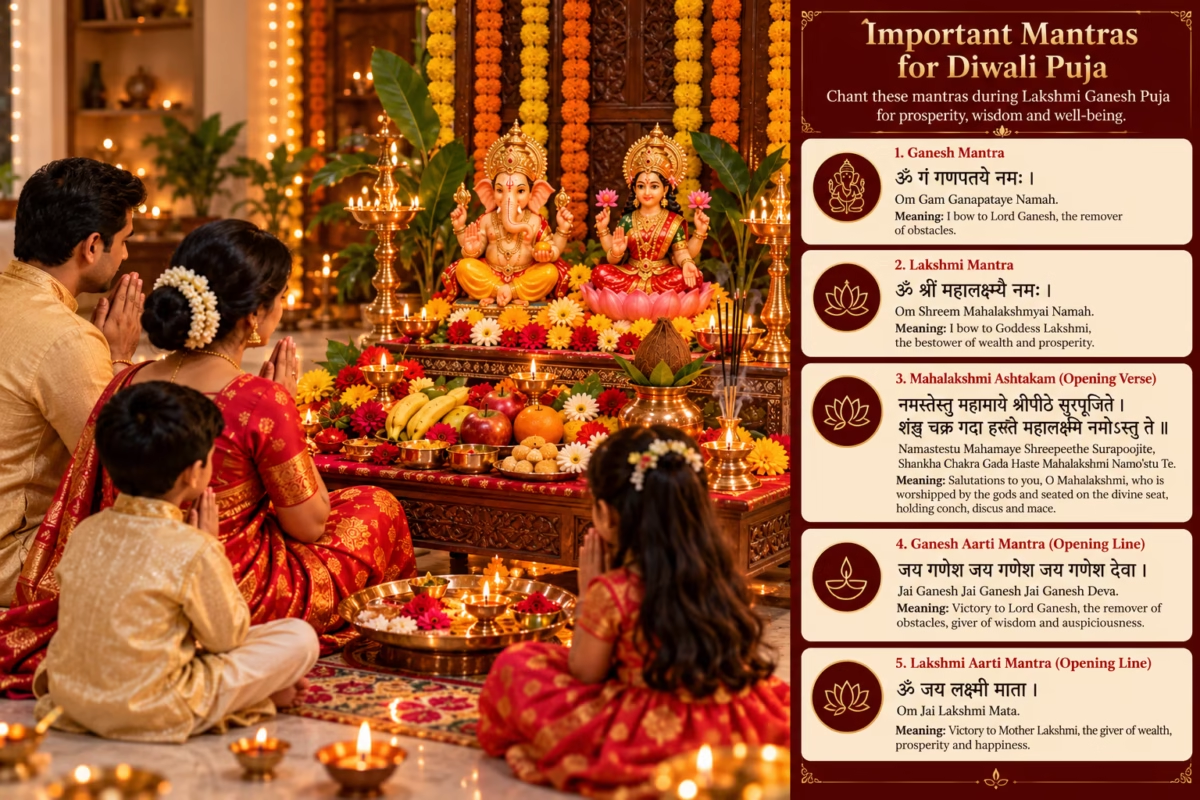
| For | Devanagari | Transliteration (IAST) | Meaning |
|---|---|---|---|
| Lord Ganesh | ॐ गं गणपतये नमः | Oṁ gaṁ gaṇapataye namaḥ | Salutations to Ganapati, with his seed syllable gaṁ |
| Ganesh Gayatri | ॐ एकदन्ताय विद्महे वक्रतुण्डाय धीमहि। तन्नो दन्तिः प्रचोदयात्॥ | Oṁ ekadantāya vidmahe vakratuṇḍāya dhīmahi, tanno dantiḥ pracodayāt | We know the one-tusked one and meditate on the one with the curved trunk; may the tusked one inspire us |
| Goddess Lakshmi | ॐ श्रीं महालक्ष्म्यै नमः | Oṁ śrīṁ mahālakṣmyai namaḥ | Salutations to Mahalakshmi, with her seed syllable śrīṁ |
| Lakshmi Gayatri | महालक्ष्मी च विद्महे विष्णुपत्नी च धीमहि। तन्नो लक्ष्मीः प्रचोदयात्॥ | mahālakṣmī ca vidmahe viṣṇupatnī ca dhīmahi, tanno lakṣmīḥ pracodayāt | We know Mahalakshmi and meditate on the consort of Vishnu; may Lakshmi inspire us |
| Lord Kuber | ॐ यक्षाय कुबेराय वैश्रवणाय धनधान्याधिपतये धनधान्यसमृद्धिं मे देहि दापय स्वाहा | Oṁ yakṣāya kuberāya vaiśravaṇāya dhanadhānyādhipataye dhanadhānyasamṛddhiṁ me dehi dāpaya svāhā | To Kubera, the yaksha, son of Vishravas, lord of wealth and grain: grant me abundance of wealth and grain, give it and cause it to be given |
For a longer recitation, the Shri Suktam, a hymn to Lakshmi from the supplementary hymns (khila) of the Rigveda, and the Kanakadhara Stotram, traditionally attributed to Adi Shankaracharya, are both recited on Diwali night.
Chopda Puja for Business Owners
For traders and business owners, Diwali marks the start of the new accounting year, and they worship the new account books as a form of Lakshmi. In Gujarat, where the new year (Bestu Varas) begins on Kartika Shukla Pratipada, usually the day after Diwali, this is called Chopda Pujan; in many trading families it is Bahi-Khata Puja.
Buy new account books, or prepare the ledger or register for the new year, before Diwali.
In the muhurta, draw a swastika in kumkum on the first page and write “Shubh Labh” on either side of it.
Write “Shri Ganeshaya Namah” (श्री गणेशाय नमः) at the top of the first page, and keep the books before the deities during the puja.
Place the cash box, keys, and payment devices beside them, and worship them with tilak, akshata, and flowers.
Make the first entry of the new year in the books only after the puja, in an auspicious Choghadiya.
Household Customs: Do’s and Don’ts on Diwali
Most of these are household customs, widely followed in North and West India rather than laid down in the dharma texts; if your family’s practice differs, follow your family. Two are rules of worship: Worship Ganesh first, and offer the sacred thread only to male deities, never to Lakshmi.
| Do | Don’t |
|---|---|
| Ring the bell softly; Lakshmi is said to dislike loud noise | Quarrel or speak harshly at home on Diwali |
| Light a lamp at every door, the kitchen, and the water source | Leave the house dark, or the main door closed during the puja |
| Leave the altar, the Kalash, and the coins in place until morning | Offer the sacred thread (janeu) to Lakshmi, or tulsi leaves to Ganesh |
| Keep a lamp burning through the night | Sweep the house or throw out rubbish after the puja |
| Share prasad and give to those in need | Lend money or give away salt and iron on Diwali night |
The custom of keeping tulsi away from Ganesh comes from a Puranic story in which Ganesh and Tulsi curse each other, usually traced to the Brahmavaivarta Purana. Tulsi remains the first offering to Vishnu, and on Diwali night it receives its own lamp (Step 13).
Why the Muhurta Matters: The Astrological View
The timing of Lakshmi Puja rests on three things in the sky: the new moon, the hour after sunset, and a fixed rising sign.
Amavasya of Kartika: Kalaratri. On Diwali, the Sun and Moon stand together in Libra (Tulā), the sign of the Sun’s debilitation, and the night is the darkest of the year: Kalaratri, the first of the four great nights of worship (see the Kali Puja section). Tradition reads the four as Diwali (Kalaratri), Mahashivaratri (Maharatri), Janmashtami (Moharatri), and Holi (Darunaratri). People light lamps on this night to symbolise knowledge and prosperity overcoming darkness, which is why the puja must fall on Amavasya.
Pradosh Kaal. The first fifth of the night, about two to two and a half hours after sunset, is the traditional time for evening worship, and householders perform Lakshmi Puja in it. Dharmasindhu, which follows the Amanta calendar and so names this night the Amavasya of Ashvina, lays down the rule:
अथाश्विनामावास्यायां प्रातरभ्यङ्गः प्रदोषे दीपदानलक्ष्मीपूजनादि विहितम्।
athāśvināmāvāsyāyāṁ prātar abhyaṅgaḥ pradoṣe dīpadānalakṣmīpūjanādi vihitam |
“Now, on the Amavasya of Ashvina, an oil bath at dawn, and in Pradosh the gift of lamps, the worship of Lakshmi, and the rest are enjoined.”
Panchang makers apply the rule in both directions: when Amavasya ends before sunset, the puja moves to the previous evening; when Amavasya covers Pradosh, the puja moves to the next morning.
A fixed lagna. Taurus, Leo, Scorpio, and Aquarius are the fixed signs (sthira rāśi). Worship in a fixed lagna is meant to make Lakshmi stay, so the puja is timed to Vrishabha (Taurus) in the evening or Simha (Leo) around midnight. Vrishabha is ruled by Venus, the planet of comfort, wealth, and beauty, and is the second sign of the natural zodiac, the house of wealth. The dharma texts fix the puja to Pradosh; the refinement to a fixed lagna within it is the jyotishi’s, and most panchangs now print it as the Lakshmi Puja muhurta.
Nishita Kaal. The eighth of the fifteen divisions of the night, around midnight, is held best for mantra practice and is preferred by those doing sadhana.
Choghadiya. Traders often open new accounts during an auspicious Choghadiya (Shubha, Labha, Amrita, or Chara) when the Pradosh window isn’t practical.
Because sunset and the rising sign change by location, you can’t simply convert a Delhi muhurta to Sydney or New York time. The tables above are calculated for each city.
May Lakshmi and Ganesh bless your home with wealth, wisdom, and peace in the year ahead. Want to know what the coming year holds for you? Talk to Ekant Sharma for a personal consultation.
Frequently Asked Questions
What time is Lakshmi Puja on Diwali 2026?
In Delhi, the Lakshmi Puja muhurta is 5:54 PM to 7:50 PM on Sunday, 8 November 2026. In Sydney, it is 8:05 PM to 9:33 PM; in New York, 5:03 PM to 6:51 PM; other cities are in the tables above.
Can I do Diwali puja at home without a priest?
Yes. Diwali puja is a household worship, and the 16 steps above are written for families to perform themselves—sincerity and the right muhurta matter more than elaborate ritual.
Which side should Ganesh be placed, and which way should I face?
Place Ganesh on the left side of the Kalash as you face the altar, with Lakshmi seated on the Kalash. Set the altar in the north-east and face east or north while you worship.
Why is Diwali night called Kalaratri?
Diwali night is Kalaratri, the first of four great nights of worship drawn from the Durga Saptashati tradition. It is the darkest Amavasya of the year, and worship and mantra practice on it are held to bear their fullest fruit. The other three are Mahashivaratri, Janmashtami, and Holi. In Bengal and the East, people worship the goddess of this night as Kali.
What if I miss the Pradosh Kaal muhurta?
Perform the puja in the Nishita muhurta around midnight, or in an evening Choghadiya, as long as Amavasya is still running. On the US West Coast, Amavasya ends at 11:01 PM, so finish before then.
What should I do with the puja items after Diwali?
Keep the coins and the Kalash coconut in your safe or puja place for the year. Immerse flowers and leftover samagri in flowing water or place them under a tree, and share the prasad.
Why do Bengalis worship Kali instead of Lakshmi on Diwali?
In Bengal, Assam, Tripura, and Odisha, Bengalis worship Lakshmi on Kojagari Purnima, and Diwali Amavasya belongs to Kali. The tradition reads this night as Kalaratri, the Night of Time named in the Durga Saptashati, and Kali is the goddess of that night. Amavasya sets Kali Puja at midnight; in 2026 it falls on the night of 8 November, with Nishita in Kolkata from 10:55 PM to 11:46 PM.
Author

Disclaimer: If you make a purchase with one of our links, we may earn a fee.


